
Local review · This projection presents reviewed governance source; it is not runtime or remote publication evidence.
125 — The Store Publication Graph — Domain Mapping and Atomic Route Promotion
The Store publication graph is the durable model that joins domains, routes, files, assets, revisions, and evidence. A governed route transformation may move one route to another domain, but DNS and HTTPS remain edge witnesses rather than content authority.
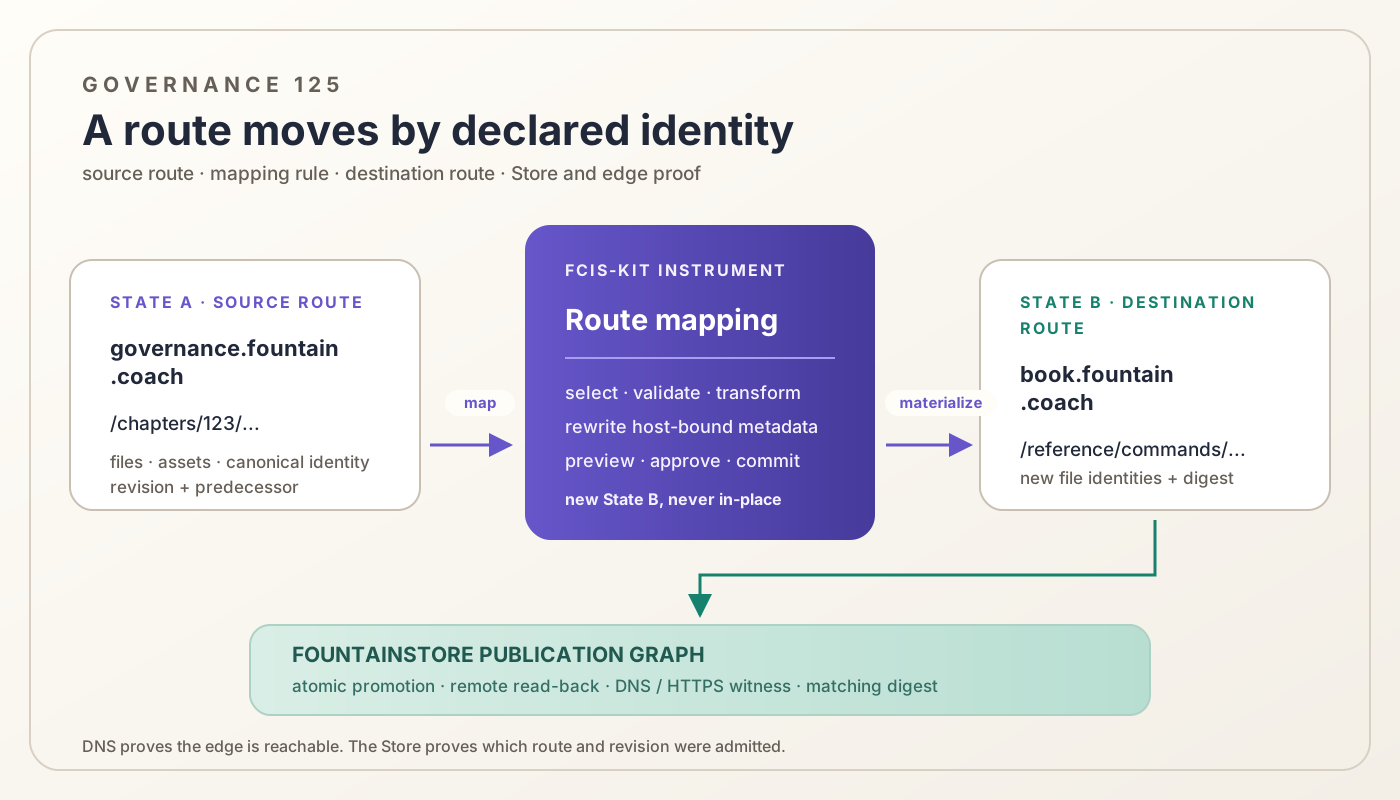
Principal illustration — a deterministic vector governance projection. It explains route transformation and publication proof; it is not a live Store receipt, DNS result, or claim that cross-domain movement is already implemented.
The decision
The Fountain Coach estate is not a pile of directories that happen to answer at different hostnames. It is a typed publication graph held by FountainStore. The graph connects a public domain to its declared role, a route to its selected files and dependencies, a revision to its predecessor, and a public response to the digest of the Store record that produced it.
source route in State A
  governance.fountain.coach /chapters/123/...
          │
          ▼
  declared route mapping
  source identity → destination identity
          │
          ▼
destination route in State B
  book.fountain.coach /reference/commands/...
          │
          ├── Store revision + predecessor
          ├── selected files + content digests
          └── DNS / HTTPS serving witness
A route-level transformation is therefore a semantic State A → State B operation followed by Store publication. It is not a filesystem move, a Caddy rule, a DNS rewrite, or an instruction to copy the whole estate.
What the graph contains
- Domain — a canonical hostname and its declared publication role.
- Route — a normalized path prefix owned by one domain.
- File — an immutable Store record identified by revision, host, and path, carrying its content type and digest.
- Dependency — a render-time relation from a selected HTML route to a same-site stylesheet, script, image, font, poster, or other declared resource. Navigation to another page is not a file dependency of the current route.
- Revision — a complete content identity with a predecessor and source/template provenance.
- Evidence — the typed receipts, lifecycle events, read-backs, AX observations, and public serving checks that establish what happened.
The graph is content-addressed and revisioned. A route transformation never changes the identity of State A in place; it creates State B with an explicit predecessor. This is what makes preview, comparison, rollback, and replay possible.
Route mapping is a governed transformation
source:
  host: governance.fountain.coach
  path-prefix: chapters/123-commands-must-be-legible-to-reasoning

destination:
  host: book.fountain.coach
  path-prefix: reference/commands
The mapping is valid only when the destination domain is already admitted for its publication role and the destination path is unambiguous. The operation selects the source bundle from the current Store snapshot, applies the explicit mapping, and produces a new bundle whose every file carries the destination host and normalized destination path.
Canonical URLs, Open Graph and Twitter URLs, JSON-LD URLs, same-site resource references, alternate links, and route metadata must either be rewritten deterministically or be reported as a human-resolvable conflict. A byte-identical file with stale canonical metadata is not a successful domain move.
“Publish the destination” and “retire or redirect the source” are different operations with different evidence. The writer must choose the latter explicitly.
Three authorities, one connected result
| Boundary | Owns | Does not own |
|---|---|---|
| Semantic transformer | State A, State B, mapping rule, semantic diff, metadata rewrite decision | DNS, TLS, serving, credentials, deployment |
| FountainStore graph | domain/route/file identities, revision, predecessor, dependencies, receipts, atomic promotion | meaning invented from a response, certificate issuance, external DNS mutation |
| Edge adapters | DNS, certificate, TLS, host admission, HTTP serving witness | page meaning, Store revision, semantic approval |
A DNS record pointing to the server does not prove that the desired Store route was promoted. An HTTP 200 does not prove that the bytes belong to the intended revision. A Store receipt does not prove that public DNS points to the edge. Each claim needs its own witness.
The server-side instrument
The route transformer is a server-side Swift FCIS-KIT instrument so the same contract can run on macOS and on the headless deployment host. Its MIDI2 facade exposes identity, version, input/output schemas, supported mapping operations, lifecycle, cancellation, evidence addresses, and claim boundary through MIDI-CI and Property Exchange.
route.mapping.preview → read State A, validate mapping, calculate State B, return diff without mutation
route.mapping.commit  → require matching approval, materialize State B, persist lineage, publish selected route
These names describe the required instrument boundary; they do not claim that the operations are already present in the current runtime. Until the instrument is admitted and accepted, the existing same-host route publisher remains the only established route operation.
Preview, promotion, and rollback
- resolve source and destination identities from the live Store graph;
- validate admitted domains, paths, and collisions;
- calculate State B and show the route/file/metadata diff;
- obtain explicit approval;
- persist State B, predecessor, mapping identity, and digests;
- publish only the selected destination route through native Store-to-Store sync;
- verify typed remote read-back, public DNS/HTTPS, and matching digest; and
- retain State A for rollback until source retirement is separately accepted.
A failed patch, missing certificate, stale DNS, digest mismatch, or conflicting route leaves the previous published snapshot current.
Acceptance and claim boundary
This chapter defines the route-mapping contract. It does not claim that the cross-domain transformer, destination-host rewriter, DNS adapter, or multi-domain promotion matrix is implemented.
Acceptance of one mapping requires source and destination route identities, an approved mapping and diff, a new State B revision and predecessor, typed destination-host/path read-back with matching digests, atomic promotion, a DNS/HTTPS witness, and a public response matching the promoted Store digest.
Rules
- FountainStore owns the durable publication graph and immutable route snapshots.
- A route move creates State B with an explicit State A predecessor; it never mutates State A in place.
- Mappings name source and destination domain/path identities explicitly.
- Destination files receive new typed identities; stale host-bound metadata is rejected or deterministically rewritten.
- Navigation links are not silently treated as render-time dependencies of a bounded route.
- Publishing a destination and retiring the source are separate, explicitly authorized operations.
- The transformer owns meaning and mapping rules; the Store owns durable publication state; edge adapters own DNS, TLS, and serving witnesses.
- Cross-domain publication transfers only the selected route bundle and its declared render-time dependencies.
- Failed validation or promotion leaves the previous published snapshot current.
- No claim of estate membership is made without Store identity, remote read-back, and public digest evidence.
Governing sentence
The Store publication graph turns domain movement into a reversible, evidenced State A → State B transformation: the transformer decides the mapping, FountainStore records and promotes it, and DNS/HTTPS prove only that the public edge serves the admitted result.