
Reference · Retained for architectural history and context; it is not, by itself, the current operational authority.
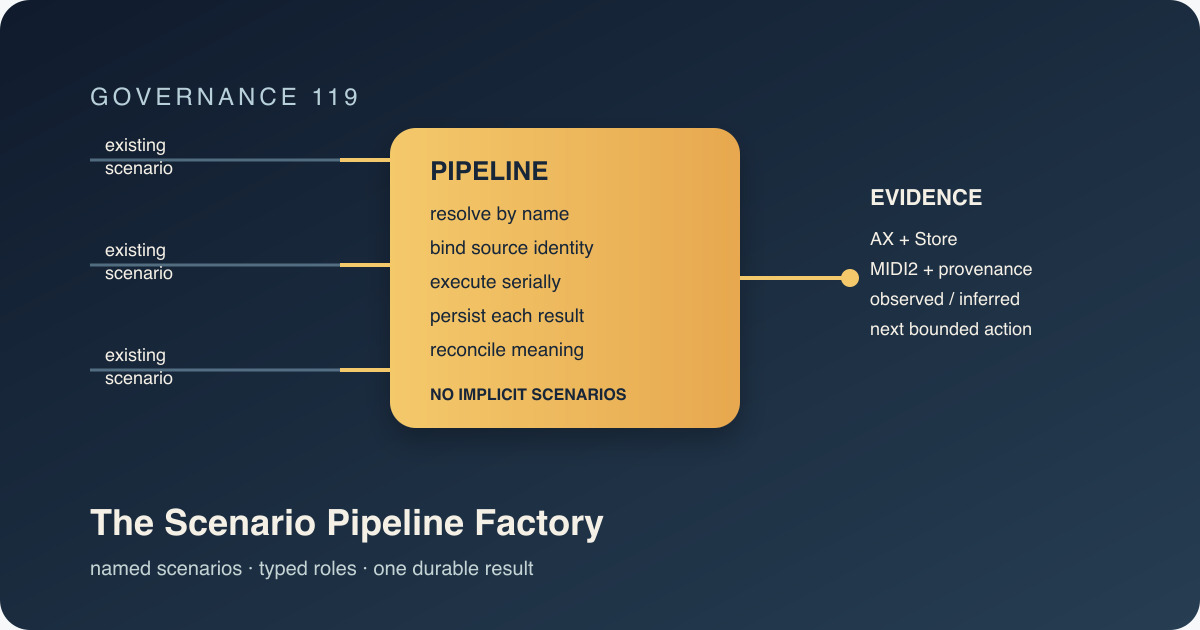
119 — The Scenario Pipeline Factory
Chapter summary: Reframe composes existing named scenarios into reusable, serial pipelines. A pipeline definition is a durable plan with explicit stage roles, dependencies, evidence, and boundaries; it is not a second scenario authoring system and it never turns a design contract into executable behavior by assertion.
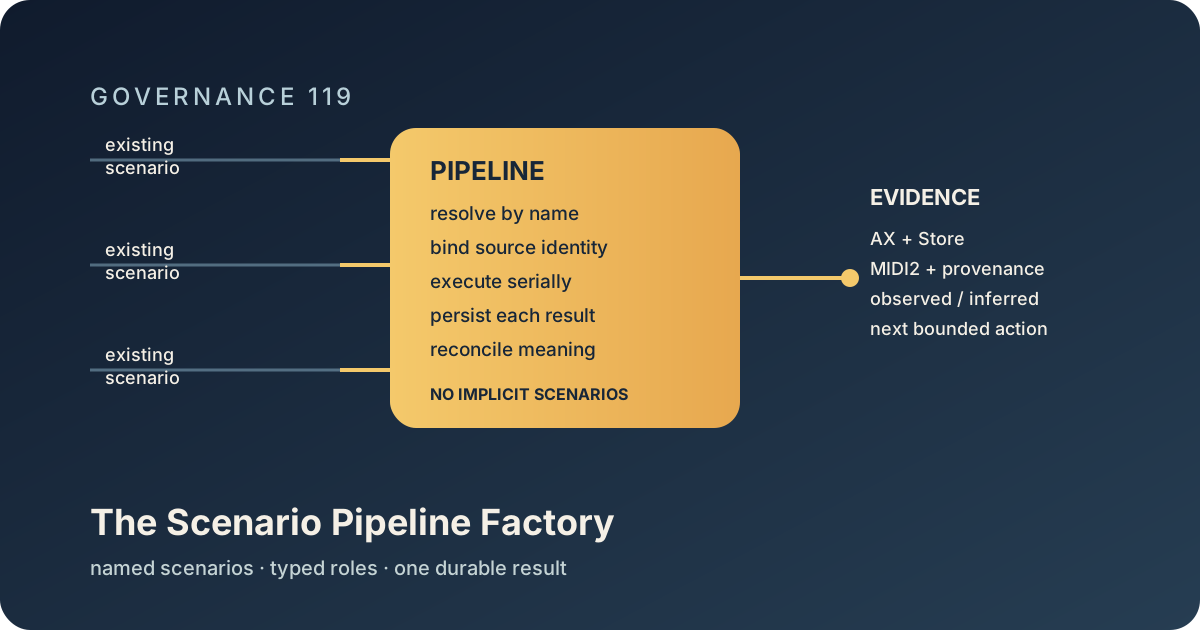
Principal illustration — a deterministic vector governance projection. It explains the factory's shape; it is not a live execution receipt, an acceptance result, or proof that every pipeline stage has an executor.
The decision
Reframe SHALL provide one governed pipeline model for composing existing named scenarios. A pipeline SHALL be named, versioned, source-addressed, ordered, and durably persisted. Its stages SHALL retain the identity and claim boundary of the scenarios they reference.
Pipeline creation is composition. It is not scenario authoring, scenario compilation, source mutation, publication, or acceptance. A pipeline MAY arrange scenarios into a new reasoning sequence, but it MUST NOT alter their declared meaning or silently promote their coverage.
existing named scenarios
        │ resolve by human-readable identity
        ▼
pipeline definition
        │ typed order + dependencies + source identity
        ▼
serial stage execution
        │ each stage consumes the prior durable result
        ▼
one Store-backed evidence ledger
Pipeline definition
Every definition MUST contain:
- a human-readable name and semantic version;
- the source or proposal identity from which its scenario references were resolved;
- an ordered list of existing scenario names;
- the capability or Swift executor responsible for each stage;
- the inputs and durable outputs of each stage;
- the terminal predicates and evidence authorities for each stage; and
- the claim boundary of the complete pipeline.
The scenario name is the writer-facing address. Internal IDs, filenames, and implementation symbols MAY accompany it for resolution and provenance, but MUST NOT replace the readable name in the command or result.
A definition with a duplicate stage, ambiguous source identity, or missing order is rejected before persistence. An otherwise well-formed definition MAY retain an explicitly named forward reference when its scenario is not yet known to the current registry. Creation stores that reference as unresolved and reports it; run cannot start until the reference resolves through the MIDI2 boundary. This permits a pipeline shape to be composed before every future instrument exists without pretending that the missing stage is executable.
Lifecycle
The writer-facing maintenance surface is deliberately small:
/maintenance pipeline create
/maintenance pipeline inspect <name>
/maintenance pipeline run <name>
/maintenance pipeline resume <name>
create resolves and persists a definition. inspect reads the definition and current ledger without executing it. run executes the stages serially from the first unresolved stage. resume continues from the last durable success after a governed failure. These operations are distinct and MUST retain their own receipts.
Pipeline creation does not require a person to supervise every stage. A human approval is required only when a stage crosses its own governed authority boundary, such as destructive mutation, paid-provider use, publication, or release. Routine validation, evidence collection, and continuation are the pipeline's responsibility.
Stage roles
Actors do not become useful merely by appearing in a contract. Each stage MUST bind its actors to a job:
| Stage role | Job | Completion evidence |
|---|---|---|
| resolver | locate the named scenario and source identity | unambiguous scenario binding |
| executor | perform the scenario's admitted operation | typed terminal event |
| witness | observe the independent surface | AX/window/VRT evidence where required |
| ledger | persist the result and provenance | FountainStore receipt |
| reconciler | compare intention, observation, and claim boundary | explicit observed/inferred/not-established result |
The pipeline may implement several roles in one Swift adapter, but it MUST preserve the distinctions in its evidence. No stage may report success because an earlier actor was present, a process started, or a file was written.
Seriality and continuity
Stages execute in declared order. Stage n+1 may start only after stage n has emitted its durable terminal result. The next stage receives the persisted result, not a reconstructed copy of the preceding stage's transient memory.
The ledger records pending, running, succeeded, and failed state, with one pipeline identity and one source identity. A failure preserves the failed stage and its evidence. Resume begins at the last stage that durably succeeded; it does not replay successful side effects unless the scenario explicitly declares replay as safe and idempotent.
Evidence and claim boundaries
Pipeline completion means that every declared stage reached its own terminal predicate and the complete evidence set was reconciled. It does not mean that the estate was published, released, or redesigned successfully unless those claims are explicitly declared and independently evidenced.
The pipeline result MUST present, for humans and machine readers:
- motivation and intended journey;
- the stage currently reached and why it is next;
- observed results and their authorities;
- inferred conclusions, labelled as inference;
- unresolved or not-established claims;
- the next bounded action; and
- the source, pipeline, scenario, Store, and executor identities.
The result is a reading of the work, not a compiler transcript. Technical events support the explanation; they do not replace it.
MIDI2 Endpoint topology and scenario composability
A scenario MAY be exposed as a MIDI2 instrument in the writer-facing vocabulary, but the normative MIDI2 topology is an Endpoint/Device containing one or more Function Blocks. Reframe presents one software MIDI2 Endpoint/Device; materialized scenarios and composed pipelines are Function Blocks within that endpoint. This is the composability boundary for future scenarios: pipeline definitions do not require a fixed census of scenario names or a runtime Swift compiler.
Each scenario Function Block MUST declare the scenario name, Function Block identity and version, supported inputs and outputs, lifecycle messages, terminal predicates, evidence authorities, and claim boundary. UMP Endpoint and Function Block discovery establish the device topology. MIDI-CI provides bidirectional discovery, inquiry, negotiation, and Property Exchange; its initiator and responder labels describe transaction roles, not separate device or instrument identities. The repository MIDI2 IDL remains authoritative for Reframe message shapes and lifecycle semantics; MIDI-CI is discovery and inquiry, not a second workflow authority.
Flex Data MUST remain within its defined MIDI2 message vocabulary: tempo, time signature, metronome, key signature, chord name, text, lyric, and ruby. It MAY carry a declared human-facing content annotation where the Function Block contract calls for one, but it MUST NOT carry scenario definitions, pipeline graphs, lifecycle control, arbitrary JSON, or evidence claims. Structured declarations and larger payloads use the established MIDI-CI Property Exchange, SysEx8, Mixed Data Set, or Reframe MIDI2 backplane contract as applicable.
The pipeline composer MAY mix and match scenario-instruments when the discovered profiles are compatible. Selection is a semantic reasoning boundary over the scenario's declared intent, operation, input/output traits, mutation boundary, terminal predicates, and the currently registered MIDI2 profiles. An identifier or filename may address a profile, but it is not by itself a reason for selection. Compatibility MUST be checked before a binding is persisted: a stage's typed inputs must accept the preceding durable result, its executor must be available in the running Reframe build, and its evidence and authority requirements must be declared.
When no registered profile satisfies the reasoned request, Reframe MUST persist a typed missing-instrument request containing the semantic requirements and the reason no existing instrument was selected. It MUST present that request as a human-readable handoff to the existing /instrument create <brief> scenario-first command. The handoff is a request, not authorization, compilation, admission, release, or execution. A maintainer may then use the governed instrument-creation path to create the missing MIDI2 Function Block once; after release or local admission, the registry can resolve the forward reference without changing the pipeline composition model.
A scenario using an already-shipped MIDI2 instrument can therefore be materialized and composed without invoking the Swift compiler. Implementing a genuinely new instrument remains a development-time Swift change and release gate; it is not a runtime pipeline operation.
Scenario materialization is consequently an admission and binding operation, not compilation. It resolves an existing named scenario to its MIDI2 instrument profile, validates the profile and typed edges, and persists one executable binding. A missing instrument is not silently substituted: it becomes the persisted missing-instrument request above, while the pipeline retains the readable forward reference and remains non-runnable. Materialization MAY be performed in batch for a reviewed set of existing contracts; it MUST NOT invent scenario behavior or strengthen any claim.
UMP replay and evidence cohorts
Each scenario-instrument execution SHOULD retain a correlated UMP command/result trace. A cohort test MAY compare an original pipeline run with one or more UMP replays through the same governed Swift Reframe runtime. The comparison MUST use the decoded MIDI2 lifecycle, terminal predicates, evidence references, and FountainStore ledger as its semantic basis. Timestamps, process IDs, window IDs, and generated correlation IDs are run-specific unless the scenario explicitly declares them stable.
UMP is transport and replay evidence, not behavioral authority. FountainStore remains authoritative for durable stage results, receipts, and provenance; AX and CoreGraphics window-ID evidence remain authoritative for writer-visible interaction and visual claims. A replay match demonstrates reproducibility of the declared contract; it cannot extend a claim boundary or establish publication or release by itself.
Kit and runtime ownership
FountainCoachMaintenanceKit owns the typed maintenance operations, pipeline definition, validation, state machine, and evidence boundary. ReframeSkillKit owns the Reframe skill identities. MIDI2 Function Blocks own executable behavior within the Endpoint/Device contract; Reframe provides the Swift Endpoint/Device adapter and routes scenario and pipeline Function Blocks through the MIDI2 instrument contract. FountainStore owns durable definitions, stage results, and receipts. Agent procedures may explain how to operate the system but are not runtime authority.
No Python, Node, shell launcher, guessed HTTP route, or filesystem convention may serve as the pipeline executor when the declared Swift kit and host adapter are available.
Governing rules
- Compose named scenarios; never create an implicit scenario as a side effect of
pipeline create. - Resolve every source identity before persistence; retain an explicitly named unresolved scenario only as a reported forward reference, never as an executable stage.
- Keep creation, inspection, execution, resume, publication, and release as separate operations.
- Execute serially and continue automatically across ordinary stages.
- Persist every transition and consume prior-stage results from FountainStore.
- Stop only at a typed failure or an explicitly governed human authority boundary.
- Preserve each scenario's claim boundary; pipeline composition cannot strengthen evidence.
- Report motivation, observation, critique, learning, and next action in human-facing language.
- Treat the Reframe MIDI2 Endpoint/Device and its scenario or pipeline Function Blocks as the composability boundary; do not require runtime compilation of a new pipeline.
- Use UMP Endpoint/Function Block discovery for topology, MIDI-CI for discovery/inquiry/negotiation and Property Exchange, and UMP for typed transport/replay, while retaining IDL, FountainStore, AX, and CoreGraphics as their respective authorities.
- Do not use Flex Data as a generic scenario or pipeline control plane; its defined content messages remain the only admitted Flex semantics.
- If semantic selection finds no registered MIDI2 instrument, persist the typed missing-instrument request and present the governed instrument-creation handoff; never compile, authorize, or substitute an instrument silently.
Governing sentence
Reframe shall turn existing named scenarios into one durable, serial, evidence-bearing reasoning sequence without inventing scenarios, laundering technical completion into human meaning, or making the writer supervise the machine.