
Current spatial-thinking boundary · The maintained boundary for source-addressed semantic interpretation, structured Teatro spatial scores, deterministic rendering, and traceable scenographic proposals.
Semantic Scenographer — Think with the Work in Space
Chapter summary: Reframe may turn source-addressed dramatic and semantic relations into structured spatial propositions. The Semantic Scenographer interprets; Teatro scores and renders; neither becomes the authority for the source or for uncertainty.
Purpose
Reframe needs a way to think with dramatic material spatially without confusing spatial imagination with source fact. The Semantic Scenographer is that instrument.
It asks:
What spatial arrangement would make the relations in this material perceptible?
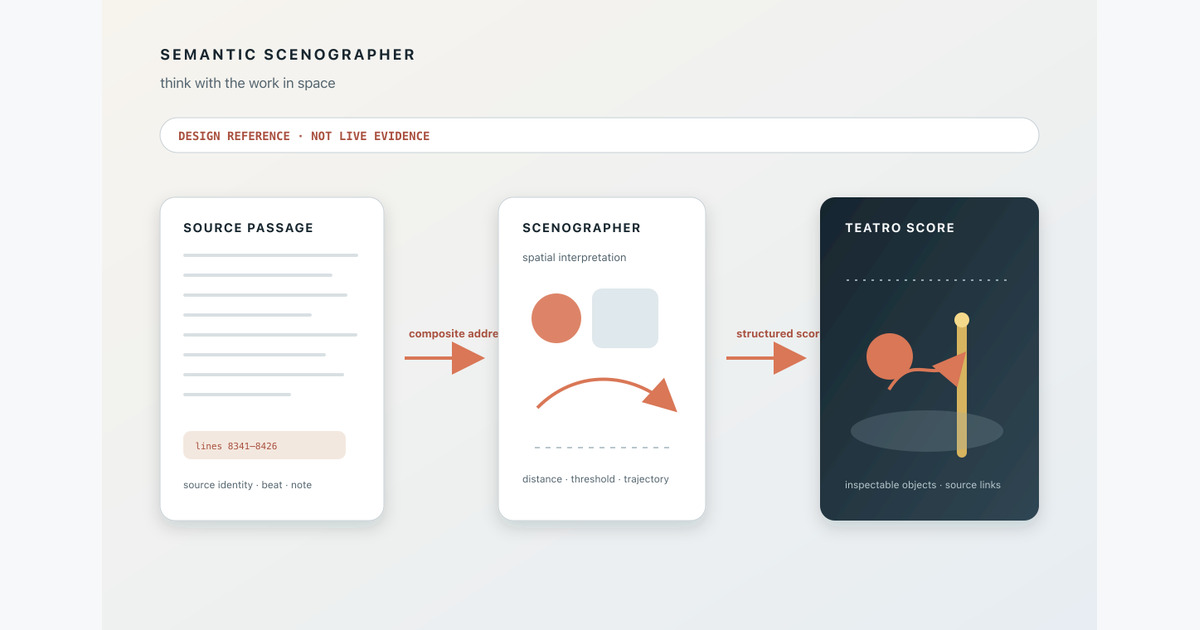
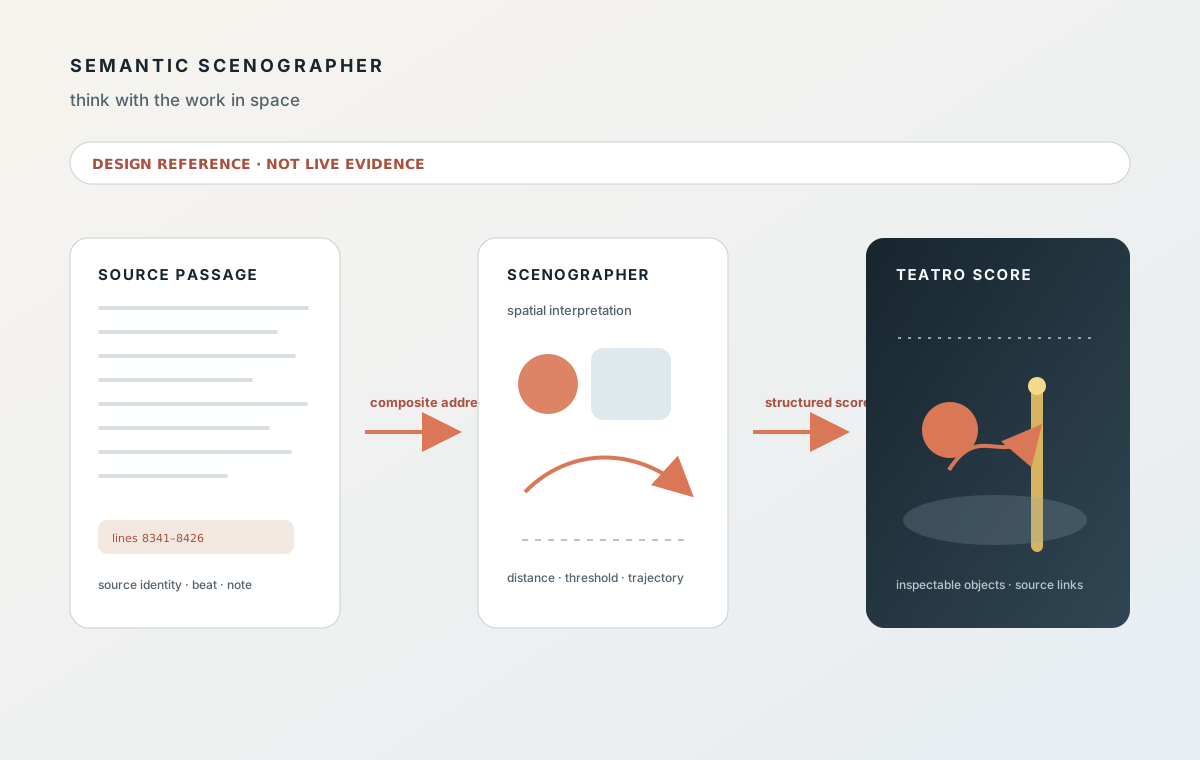
It does not ask an image generator to decorate a scene. It receives material already situated in Reframe's semantic spine — source identity, source range, beat or movement context, lane or note identity where applicable, uncertainty state, and other admitted evidence — and proposes how those relations might exist in space.
The governing distinction is:
Reframe establishes what is there.
The Semantic Scenographer proposes how it might exist in space.
Teatro scores and renders that proposition.
The illustration above is a design reference for this boundary. It is not a runtime screenshot, Store receipt, AX capture, or live acceptance claim.
The decision
The Semantic Scenographer is a distinct downstream instrument. It is not Source View, not Lane View, not an image generator, and not a replacement for the uncertainty model.
The current writer-facing Lane View direction is therefore retired as a product navigation surface. UncertaintyScoreKit remains valuable as an internal model projection: it stores and exposes uncertainty states, spans, and addresses for downstream consumers. Reading Navigation remains the user's semantic index. The scenographer may consume those addresses, but it does not create a second navigation system.
source / beat / lane / note
          ↓
composite semantic address
          ↓
AI scenographic interpretation
          ↓
structured Teatro composition
          ↓
deterministic SVG, animation, storyboard, or score
Authority boundaries
Source View
Source View remains authoritative for the exact Markdown stream and supported .fountain subset. The scenographer may cite a source range and propose a spatial reading of it, but it may not rewrite, summarize over, or replace the source. A scenographic object is never evidence that the source literally contains its geometry.
UncertaintyScoreKit
UncertaintyScoreKit remains the internal authority for uncertainty structure: lanes, notes, states, spans, and composite addresses. The scenographer can use a note's state as an input condition — for example, an unresolved question may become an open distance or threshold — but it may not invent, close, or conceal that uncertainty.
Reading Navigation
Reading Navigation establishes the user's semantic starting point. The writer can select a passage, beat, movement, question, or note and ask Copilot to stage the relations there. The scenographer may return a selectable spatial proposal, but selection is a shortcut back to the already-established address, not a new finding.
Teatro
Teatro is the structured representation and rendering boundary. It may express geometry, transitions, symbolic objects, spatial scores, and animation. It does not own source parsing, uncertainty meaning, provider choice, Copilot mediation, or AX truth.
Instrument role
The scenographer converts semantic relations into spatial form through a small declared vocabulary:
- figure, object, field, zone, distance, threshold, boundary, and axis;
- entry, exit, void, density, isolation, cluster, and witness;
- foreground, background, trajectory, pause, repetition, overlap, containment, exposure, and concealment.
These are compositional primitives, not hidden facts. A relation such as “A seeks contact, B withdraws, and the question remains open” might become an advancing trajectory, a receding zone, and an unresolved distance field. The result is explicitly a scenographic proposition.
The initial capability vocabulary should remain small and typed. Candidate operations are:
scenography.stage
scenography.spatialize
scenography.score
scenography.sequence
scenography.compare
scenography.revise
The final operation names, input contract, and lifecycle belong in the Fountain Coach capability registry and MIDI2 instrument contract. They must not be invented independently by a UI.
Teatro composition contract
A composition is structured rather than flattened imagery:
Stage
 ├── Field
 ├── Figure
 ├── Object
 ├── Threshold
 ├── Path
 └── Annotation
Each interactive object should preserve:
- a stable object identity;
- its source document and exact source range;
- the originating beat, movement, lane, or note address where applicable;
- a declared spatial role;
- geometry and temporal state;
- label, visibility, and transition data;
- the instrument, score, renderer, and provenance versions.
For example:
TeatroObject {
    id: "threshold-04"
    sourceDocumentID: "screenplay:fixture:source"
    startLine: 8341
    endLine: 8426
    laneID: "questions"
    noteID: "q-018"
    role: "threshold"
}
The exact serialized type remains a kit contract to be admitted. The address relationship is already a governance requirement.
Copilot experience
The writer remains in Copilot. They may ask:
- “Stage the conflict in this passage.”
- “Show me how these three movements relate spatially.”
- “Make the distance between them visible.”
- “Turn this beat into a spatial score.”
- “Give me three different stagings of the same source.”
- “Keep the source fixed but make the threshold more dominant.”
- “Show the unresolved question as a spatial condition.”
Reframe resolves the relevant semantic address and admitted context before the instrument runs. The writer does not manage SVG, layout engines, geometry stores, or renderer credentials. The projection may appear beside the manuscript, on a dedicated stage surface, or in a responsive contextual arrangement. Layout is implementation detail; identity and addressability are the contract.
AI responsibility and limits
The AI may choose which relationships deserve emphasis, select declared spatial primitives, compose several relations, produce temporal sequences, and generate alternative stagings.
It may not:
- invent source facts and present them as established;
- mutate the manuscript without a separate authorized operation;
- reinterpret uncertainty as certainty;
- hide an unresolved state or failed input;
- treat a decorative inference as evidence;
- persist a spatial proposal as a semantic finding merely because it rendered.
Every result must remain identifiable as a scenographic proposal.
Determinism, provenance, and variants
The interpretive act and the render must remain distinguishable. Once the AI has produced a structured Teatro score, rendering should be deterministic wherever possible from:
source identity
semantic addresses
instrument version
AI-generated Teatro score
renderer version
render parameters
The resulting artifact carries a digest and provenance record. Re-rendering the same stored score with the same renderer and parameters must produce the same geometric result.
Scenography is exploratory. Several variants may be anchored to the same source address:
A — compression
B — distance
C — shared field
Variants remain distinct proposals. None is promoted automatically to source truth, uncertainty truth, or canonical staging.
Image generation is downstream
An image renderer may later interpret a Teatro score, but it must remain downstream:
source → Semantic Scenographer → Teatro score → optional image interpretationThe structured score remains primary because it can be inspected, discussed, revised, compared, addressed, and deterministically rerendered. A flattened bitmap cannot replace that lineage.
Address-preserving interaction
Selecting a Teatro object must preserve the same semantic address through the workspace:
focus Teatro object
    → focus linked Lane/View context where applicable
    → scroll Source View to the exact range
    → expose the same address through AX
If the object has no unambiguous source address, it must be presented as unlinked proposal material. It may not guess or silently attach itself to a nearby passage. If multiple notes overlap, the composite identity remains composite.
Acceptance order
The first bounded implementation should:
- select one exact source range;
- resolve its semantic address;
- optionally include linked beat and uncertainty context;
- request one structured Teatro proposition;
- render it deterministically as SVG;
- preserve source addresses on every linked object;
- expose every interactive object through AX;
- support object selection back to Source View focus;
- support revision and alternative staging as separate proposals; and
- persist the Teatro score and provenance separately from the source.
Acceptance requires proving exact source identity, absence of source mutation, absence of invented uncertainty, stable object identity, AX parity, deterministic rerender, distinct variants, and visible failure for missing or insufficient semantic input. Attractive SVG alone is not acceptance.
Relationship to existing governance
This chapter extends Chapter 24, Chapter 36, Chapter 79, and Chapter 98. It supersedes the writer-facing Lane View direction in Chapter 99, while retaining Chapter 99's separation of source authority, semantic addresses, and projection ownership where compatible. Chapter 08 remains the evidence authority for AX, Store, window-ID, and independent acceptance.
Governing sentence
The Semantic Scenographer receives source-addressed meaning from Reframe, uses AI to propose spatial relations, and expresses those relations as structured Teatro scores whose objects remain inspectable and traceable to the work; it may imagine space, but it never becomes the authority for the source or the reading.