
135 — Reframe iPad as a Scenario-Driven Creative Host
Chapter summary: Reframe SHALL treat iPad as a first-class creative and performance target. A scenario may resolve governed FCIS Instruments into an executable topology that joins sound, interaction, semantic meaning, spatial representation, persistence, and human performance without turning Reframe into a conventional DAW.
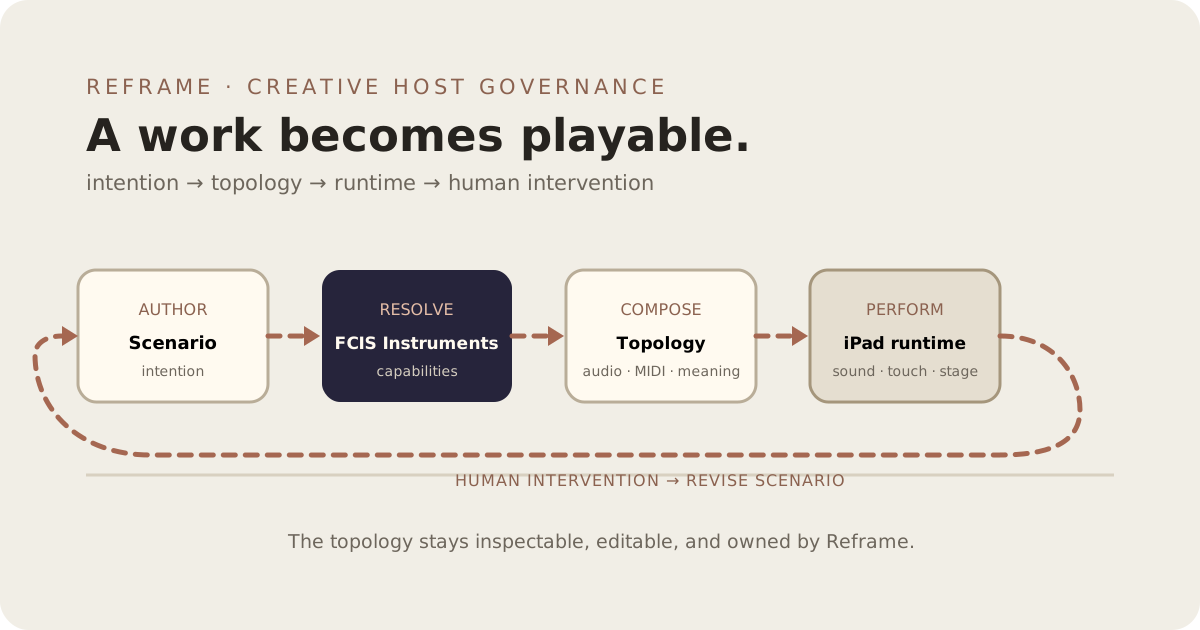
Principal illustration — a design projection of the proposed chain. It is not an AUv3 bundle, AUM discovery proof, MIDI2 terminal event, audio measurement, device acceptance, Store receipt, or release claim.
The decision
Reframe for iPad is governed as a scenario-driven creative host. The canonical progression is Work → Scenario → FCIS Instruments → Executable Topology → Runtime → Experience. The topology is part of the authored work: it may be negotiated and generated, but it remains visible, inspectable, editable, and subject to human acceptance.
iPad is not a remote control for macOS. Touch interaction, portable audio hardware, Core Audio, AUv3, Core MIDI, performance, and document-oriented creative work are native conditions of this target. macOS and iPad may emphasize different working surfaces while sharing one governed Reframe model.
The host boundary
A third-party host such as AUM is evidence, interoperability reference, and comparative target—not Reframe's canonical model. AUv3 describes executable audio capability; an FCIS Instrument describes a governed capability with identity, parameters, semantic purpose, runtime and persistence requirements, authority boundaries, and failure conditions. Reframe owns the topology representation.
scenario intention → capability resolution → FCIS Instrument selection → executable audio / MIDI / MIDI2 topology → human-readable runtime projection → performance and persistenceMIDI and MIDI 2 provide runtime interaction and hardware continuity without defining the semantic graph. Teatro may project the same governed relationships spatially; it must not become a decorative explanation of a hidden graph.
Human intervention
Scenario compilation creates negotiable executable material, not an invisible agent-owned arrangement. The human must be able to understand what instruments exist, how they connect, what the scenario controls, which parameters matter, and what remains directly playable. An agent may discover, select, instantiate, route, expose, and persist capabilities only through governed Reframe operations.
Initial vertical slice
The first implementation remains deliberately small: discover installed AUv3 components; instantiate one software instrument and one effect; connect them to output; inspect parameters; expose selected parameters; accept MIDI; persist the topology; close and reopen the work; and deterministically reconstruct the environment. This proves human intention → scenario → instrument topology → native execution → human intervention → persistence without requiring DAW feature parity.
Rules
- Reframe iPad is a first-class creative and performance target, not a Mac remote control.
- The canonical creative topology belongs to Reframe and is independent of AUM or another host's private session format.
- AUv3 components enter scenario reasoning through governed FCIS Instrument representations.
- Scenario compilation may request capabilities and propose topology, but it must preserve human inspection, intervention, and acceptance.
- MIDI and MIDI 2 are interaction mechanisms; neither replaces the semantic topology model.
- Teatro may project executable relationships spatially while retaining the same governed state and claim boundary.
- Persistence distinguishes intention, resolved topology, component identity, parameter state, routing, runtime state, human changes, generated changes, and unavailable dependencies.
- The first implementation proves one native vertical slice; it does not claim a DAW, AUM compatibility, MIDI2 acceptance, or release until those have their own typed evidence.
Governing sentence
Let a Reframe scenario make a governed creative topology playable on iPad while keeping the graph visible, the human authoritative, and every runtime or release claim bounded by its own evidence.