
127 — The Estate Template Is the Publishing Path
Chapter summary: Fountain Coach publishing follows a direct-static path: Codex authors each route as complete, checked-in HTML, CSS, and JavaScript under the Fountain Coach Publication Core, and the native FountainStore publication operation promotes those finished bytes. Personal Pointer remains the founder publication and design provenance of that core; institutional domains vary in meaning without becoming Personal Pointer projections.
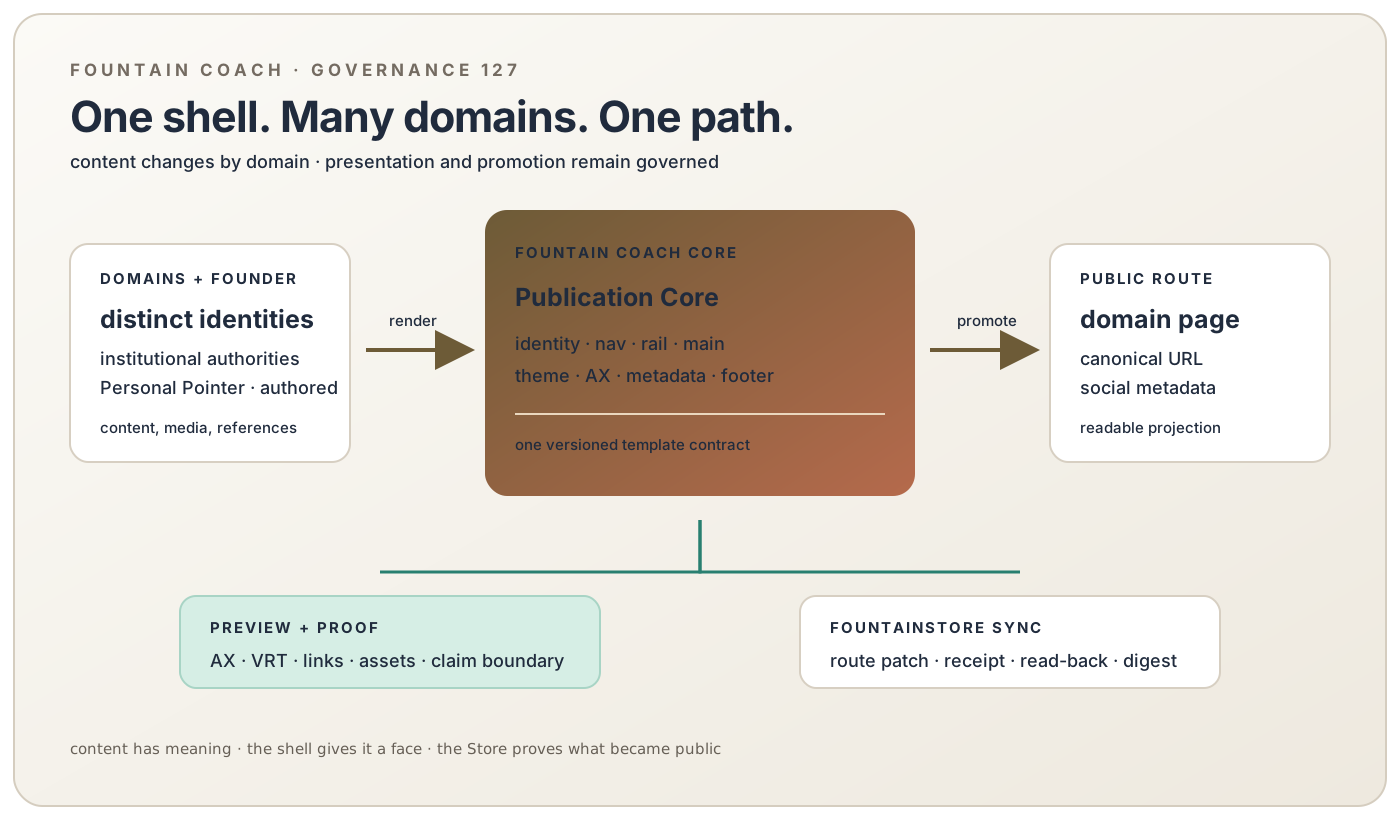
Principal illustration — a Teatro-style design projection. It describes the governed template path; it is not a live Store receipt, a deployment result, or evidence that every domain has already been transformed.
The decision
Closed migration-window rule
When the canonical renderer already exists in its owning FountainStore repository but has not yet reached the consumer's named package release, the maintainer may open one recorded migration window. During that window the owner repository is tested and released first; a consumer may inspect the local source only to diagnose the missing API. It may not vendor, fork, or execute a second renderer, claim live acceptance, or retain a path dependency.
The window closes only after the renderer is present in a named FountainStore release, the consumer pins that release, dependency coherence passes, and searches find no override. Once closed, the ordinary single-authority rules below apply without exception. This rule records the migration that moved the Chapter 127 renderer into its released owner; it does not create an ongoing development fallback.
The Fountain Coach estate adopts one reusable publishing template. Codex applies that contract while authoring each route, producing complete static HTML, CSS, and JavaScript. The publication adapter promotes that reviewed result. There is no intermediate site generator, Markdown-to-HTML compiler, client-side content hydration, or runtime shell wrapper in the publication path.
domain source and route identity
  → canonical route identity
  → Codex-authored static HTML / CSS / JavaScript under the Publication Core
  → metadata / accessibility / asset checks
  → local preview and AX/VRT proof
  → route-scoped FountainStore publication
  → typed remote read-back
The shell is not regenerated at request time and is not copied into every domain as a new design. It is one versioned authoring contract embodied directly by each checked-in route. A domain may change its title, role, sidebar entries, content blocks, language, and density. It may not remove the estate identity, navigation, theme control, accessibility surface, provenance, legal footer, or publication state.
Direct-static implementation rule
Codex is the authoring-time manager of the estate projection. It may use its repository editing and validation tools to compose or revise a route, but the admitted output is the route itself: human-inspectable HTML plus referenced CSS, JavaScript, images, and fonts. A browser must be able to render that output without fetching a content record, running a template compiler, applying a second shell, or reconstructing the page from Markdown or JSON.
FountainStore may retain provenance, route identity, revisions, receipts, and the final route payload. Those records do not authorize a browser-side or deployment-side generator. Reframe's semantic browser mirrors the already-complete route and may scope its root-relative assets to the selected host; it must not redesign, hydrate, or wrap the page.
Amendment — institutional core and founder projection
The first Chapter 127 candidate was extracted from the Personal Pointer design and called the shared template the “Personal Pointer shell.” That name correctly recorded design provenance but incorrectly collapsed two identities. Personal Pointer is Benedikt Eickhoff's authored publication. Fountain Coach is the institutional estate whose TLD names the identity and whose specialized domains own separate public questions under Chapter 92.
The extracted shared authority is therefore named Fountain Coach Publication Core. It retains the reviewed shell grammar first proven by Personal Pointer—typography, spacing, navigation behavior, theme controls, responsive frame, metadata slots, accessibility semantics, and provenance treatment—without transferring Personal Pointer's authorial identity into Book, Governance, MIDI2, Instruments, Status, or another institutional projection.
Fountain Coach Publication Core
  ├── institutional domain projection
  │     └── domain-owned content, authority, evidence notation, and local navigation
  └── founder publication projection
        └── Personal Pointer: authored blog identity and its own content semantics
Personal Pointer is connected to the estate by a typed founder-publication edge. It is not an institutional authority parallel to Governance, MIDI2, or Status, and a link to it establishes no runtime, release, evidence, legal, or admission claim. Its local content grammar currently distinguishes a Memory Vector, an image collection, from a Teatro Score, one resulting image paired with authored Fountain text at a semantic post URL. Those are Personal Pointer content templates, not mandatory estate-wide content types.
This amendment changes governance vocabulary and ownership. It does not by itself rename implementation symbols, rewrite scenario contracts, migrate Store records, publish the Personal Pointer route, or reconcile Book scenario status. Each of those effects requires a subsequent bounded scenario and its own authority-specific evidence.
The CMS-shaped layers
| Layer | Owns | Must not own |
|---|---|---|
| Static route source | complete HTML, domain meaning, body, media, dates, references, status | runtime generation or publication authority |
| Route manifest | canonical host, path, page identity, predecessor, source record | guessed availability or deployment state |
| Fountain Coach Publication Core | institutional mark, header, estate navigation, theme/icon control, sidebar frame, main frame, footer, metadata slots | domain claims, founder authorship, Store writes, credentials |
| Codex authoring pass | content composed into the shell's named regions before review | a deployed generator, alternate shell, or second route map |
| Founder publication projection | Personal Pointer authorship, blog navigation, Memory Vector collections, Teatro Score posts | institutional authority, scenario status, runtime or release evidence |
| Preview and acceptance | local rendering, AX semantics, VRT evidence, link/asset checks | production proof |
| FountainStore adapter | authenticated route-scoped promotion and typed read-back | browser layout or an unreviewed whole-estate dump |
The shell contract
Every public route renders these regions in the same order:
- Identity header — Fountain Coach mark, publication role, canonical estate navigation, theme control, and icon-only navigation control.
- Domain rail — the domain's reading index or collection navigation, exposed as an accessible navigation landmark.
- Main frame — breadcrumbs, publication state, domain-owned content, and semantic headings.
- Content primitives — the domain may use articles, galleries, score plates, tables, or reading pages, provided each has stable identity, alt text, and a claim boundary.
- Legal and provenance footer — sibling publications, legal notices, privacy, accessibility, copyright, compliance, and source/provenance links.
The open-hand spring is the estate mark. The Publication Core supports light, dark, and system themes. The icon-only control is a presentation mode, not a second information architecture: accessible names remain available when labels are hidden.
An institutional route identifies Fountain Coach first and its local authority second. A Personal Pointer route identifies Benedikt Eickhoff and Personal Pointer first, while retaining a legible founder relationship to Fountain Coach. Shared composition does not erase this difference in speaking subject.
Route identity is the join key
The route manifest is the CMS-like binding between a domain record and its public URL. It declares the host, normalized path, content identity, shell revision, source revision, and publication state. The browser must not infer a route from a folder name, a DNS response, or a missing page.
The same manifest drives:
- the shell navigation link;
- the canonical, Open Graph, Twitter, and JSON-LD metadata;
- the local preview route;
- the route-scoped Store operation; and
- the remote read-back assertion.
Thus a domain move is a manifest change plus a new route projection, not a file copy. The predecessor and digest remain visible so a reader can follow continuity.
One publication path
The publication operation is always estate.publication.sync: explicit local FountainStore source, authenticated remote FountainStore destination, canonical host, normalized path prefix, and typed receipt. The checked-in static route is upstream of that operation; the web server is downstream of the remote Store projection.
For one page, the operation transfers one selected route. Whole-estate synchronization requires explicit whole-estate intent. A static-directory copy, site generator deployment, Caddy copy, generic HTTP wrapper, or browser upload is not an equivalent path.
Acceptance boundary
Chapter 127 is implemented for a domain only when its local source has:
- one canonical shell revision and route manifest;
- the five shell regions and required metadata;
- domain content rendered without an iframe or alternate authority;
- AX proof for landmarks, controls, labels, and navigation state;
- VRT proof at desktop light, mobile closed/open, and declared dark state;
- every shell link landing on its declared route; and
- route-scoped FountainStore receipt, typed read-back, public HTTPS, and matching digest for publication.
Missing content roots, unresolved routes, or an unavailable Copilot destination remain not established. They are not filled with placeholder pages and are not silently redirected.
Rules
- The Fountain Coach Publication Core is the single institutional estate-template authority; Personal Pointer is its founder publication projection and recorded design provenance, not the institutional identity.
- Codex authors domain content directly into named shell regions as final HTML, CSS, and JavaScript; deployed code does not inject, compile, hydrate, or wrap that content.
- The route manifest is the join key for navigation, metadata, preview, and publication.
- Preview proves rendering; AX proves operability; VRT proves visual legibility; Store read-back proves publication.
- Publication is route-scoped by default through native
estate.publication.sync. - No iframe, generated intermediary, guessed route, or second publication authority may satisfy this contract.
- Unknown or unavailable state remains visible as
not established. - Institutional domain projections MUST identify Fountain Coach and their local authority; they MUST NOT present themselves as Personal Pointer publications.
- Personal Pointer MAY use Memory Vector and Teatro Score semantics, but those templates MUST NOT be treated as estate-wide evidence or authority types merely because they share the Publication Core.
- Moving an identity between institutional domain, founder publication, and content template is a manifest and governance change with scenario proof; visual similarity or a shared shell cannot perform that move implicitly.
- Reframe's semantic browser mirrors final route bytes and scopes their assets; it MUST NOT become a site generator.
Governing sentence
Fountain Coach has one institutional Publication Core embodied as complete static routes and one Store-backed publishing path; institutional domains contribute distinct authority, Personal Pointer contributes founder authorship and design provenance, and only preview, acceptance, and typed promotion establish what is actually public.