
Current design projection · The Teatro Web surface is visible in local preview; browser Csound and full Reframe Web parity remain unaccepted.
137 — Teatro Web Is Reframe's Governed Materialization Surface
Teatro Web is the current browser materialization of Reframe's stage vocabulary. It projects governed scene intent into an isometric WebView, while Linux/ReframeCore remains semantic authority and the user's device remains the audio-rendering boundary.
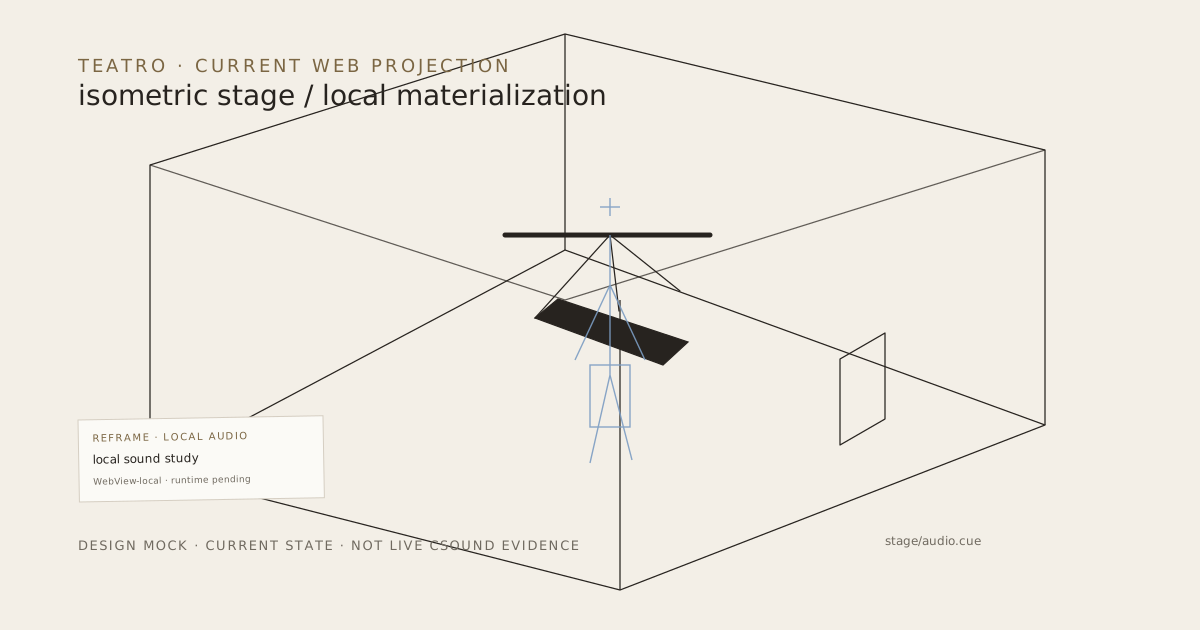
Principal illustration — current Teatro Web design projection, observed in the LAN preview. It records the present stage geometry and interaction vocabulary; it is not live Csound playback, MIDI2 terminal evidence, a Store receipt, or a completed Reframe Web acceptance run.
The decision
Teatro Web is Reframe's browser-facing materialization surface. It is a client, not a second Reframe runtime. Its scene is an inspectable projection of governed intent: an isometric room, a suspended rig, a rest-pose trace, and a small local-audio annotation. The present implementation is a design and integration slice, not a claim that every native Reframe surface has reached browser parity.
source-addressed intent → ReframeCore / FountainStore → typed MIDI2 projection → Teatro WebView
                                                                      ↘ local audio boundary
What is current
The current web surface is built in TypeScript/React with the Teatro stage engine and Three.js. It animates the stage locally and exposes an accessible control layer. Audio intent is sent through the existing stage/audio.cue boundary; the browser adapter deliberately refuses playback until a real Csound WebAssembly or AudioWorklet runtime is admitted. The visible stage therefore establishes current design continuity, not audible Csound acceptance.
The visual language is intentionally sparse: warm paper, charcoal line, muted estate accent, and one small note-like attachment for local audio. System feedback is transient and belongs to the estate information control; it is not a permanent dashboard or interface mock.
Rules
- Teatro Web is a first-class Reframe projection, never semantic or Store authority.
- ReframeCore, FountainStore, scenarios, leases, receipts, and typed MIDI2 remain authoritative outside the WebView.
- The web client consumes generated contracts and must not invent a browser-only command language.
- The Teatro scene contract names objects, relations, camera, animation, audio intent, and provenance explicitly.
- The browser renders interactive stage motion locally; it does not stream every audio sample from the authority.
- Csound WebAssembly or AudioWorklet must be prepared outside the render callback and receive only bounded events.
- A missing browser Csound runtime is a typed blocked state, never a synthesized substitute or silent success.
- Web, iPad, and macOS may use different renderers while preserving scene identity, event semantics, timing policy, and failure states.
- The deterministic scene projection may produce a landscape SVG/PNG estate illustration, but that asset remains a publication projection joined to this semantic route.
- WebView parity, audio output, MIDI2 delivery, accessibility, animation, and static export require separate acceptance evidence.
Governing sentence
Teatro gives Reframe a web face without moving its meaning: the runtime governs the scene, the WebView materializes it, and the user's device remains the place where interactive sound may eventually be heard.