
Current capability-plane boundary · The maintained FCIS-KIT Instrument Store architecture: Reframe host, MIDI2 capability contract, scenario-first admission, local/remote instruments, and evidence-bound release.
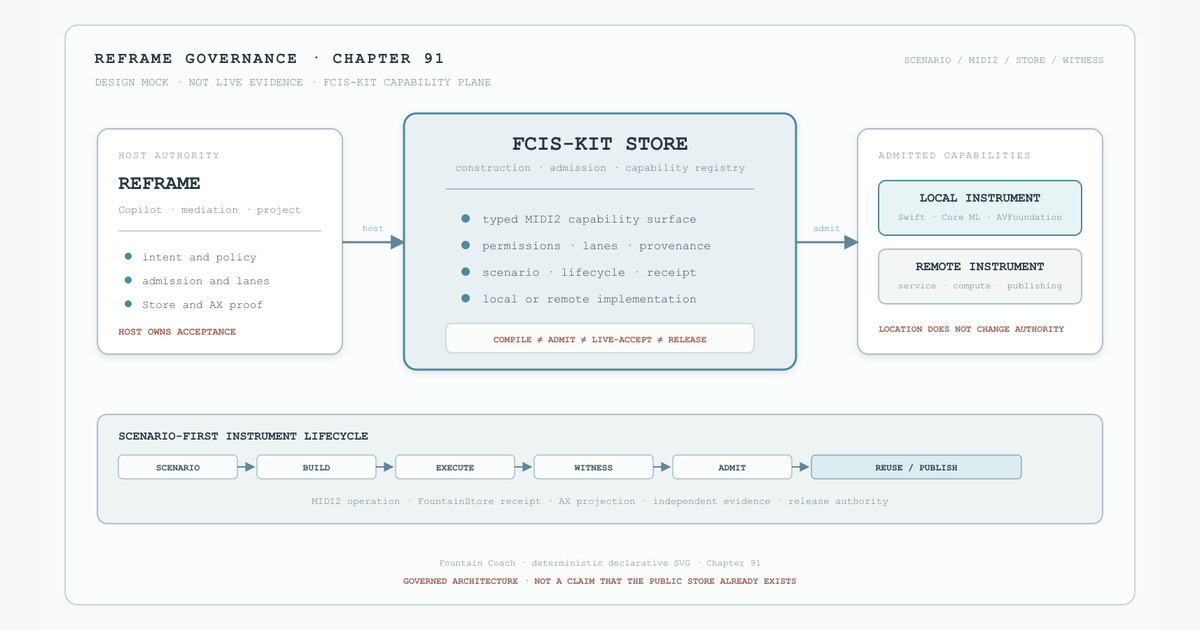
91 — The FCIS-KIT Instrument Store Is the Capability Plane
The FCIS-KIT Instrument Store is Fountain Coach's governed distribution model for software capabilities that present themselves as MIDI2 instruments. It is not a second application store, a plugin folder, or a claim that every proposed instrument already exists. This chapter governs the architecture and the boundary between a capability's claim and the evidence required to admit it.
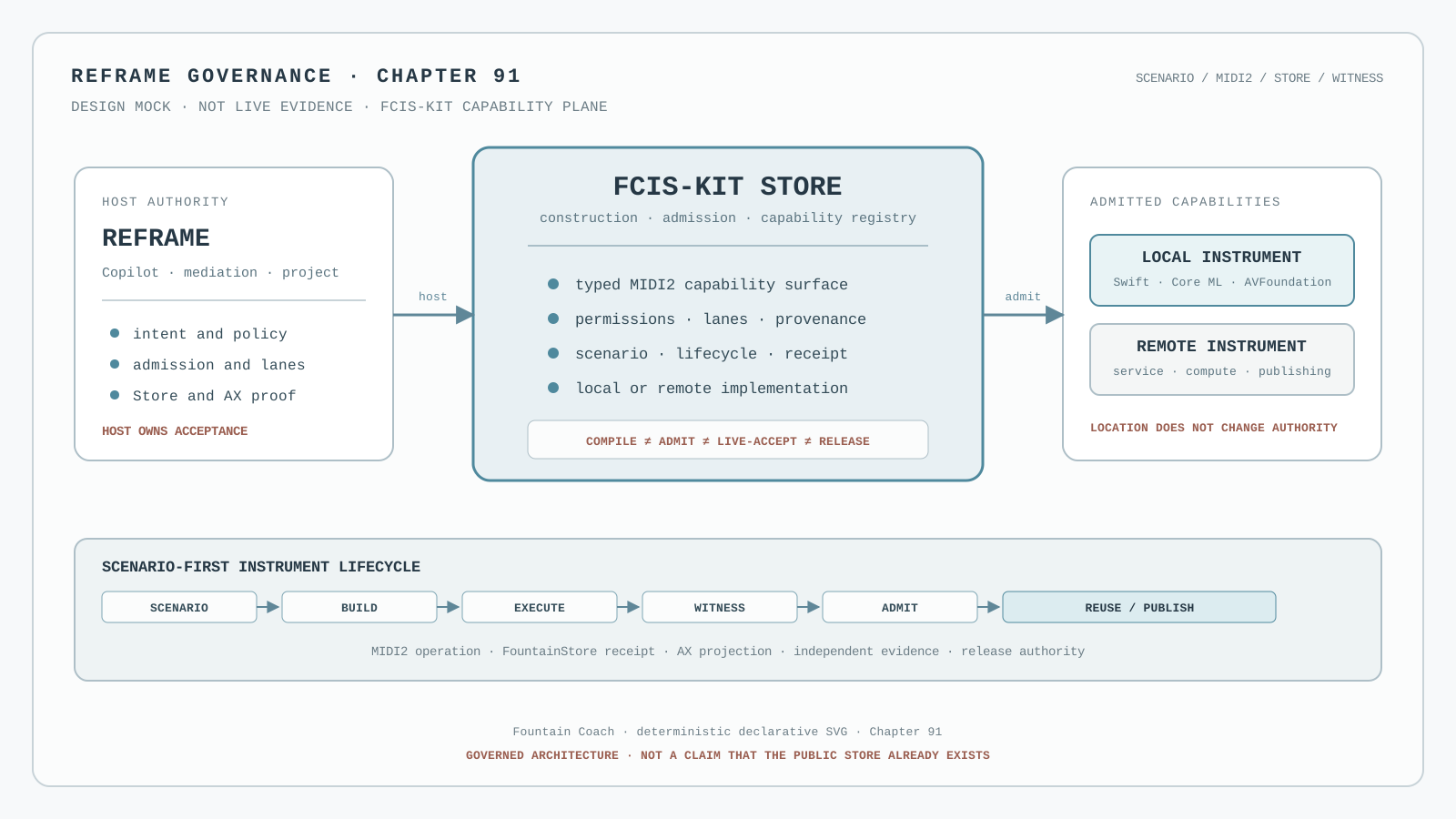
Design mock, not live evidence. The illustration is a deterministic architectural projection and contains no Store identifier, MIDI2 correlation, provider receipt, instrument result, or release claim.
The decision
Fountain Coach treats the instrument as the unit of governed capability distribution:
scenario → implementation → build → execution → evidence → admission → reuseReframe is the primary host and development environment. FCIS-KIT defines the construction boundary. MIDI2 provides the operational language. Scenarios define expected behaviour. FountainStore records durable lifecycle and receipt evidence. Independent witnesses determine which claims may be promoted.
No layer silently replaces another:
- the MIDI2 IDL defines the operation and lifecycle contract;
- FCIS-KIT defines the reusable instrument package boundary;
- Reframe mediates intention, permissions, project state, and host authority;
- the instrument owns its declared execution and reports its lifecycle;
- FountainStore proves durable effects and receipts;
- AX proves the user-facing surface;
- independent scenario and security witnesses establish acceptance; and
- release authority promotes a named build.
Mechanical constraints are FCIS contract terms
A mechanical constraint is an FCIS-declared condition represented in the executable contract and enforced by the owning kit or host adapter. It binds the runtime and the agent acting through it; it is not a prose instruction, prompt convention, screenshot, remembered procedure, or inferred boundary.
Every mechanical constraint identifies its typed FCIS/MIDI2 identity and contract version, executable admission or precondition predicate, named evaluator, typed refusal or bounded-stop state, and terminal evidence required before success or publication may be claimed.
The constraint applies to every admitted mutation path for that capability. No agent, scenario runner, instrument, or host adapter may create, widen, reinterpret, or bypass it. If it is not admitted or cannot be evaluated, the operation stops as unestablished; it does not acquire a substitute prompt, CLI flag, JSON document, human ceremony, or parallel authority. A scenario declaration or governance paragraph alone does not make a constraint mechanical: the owning runtime path must enforce the predicate and expose its refusal and terminal evidence.
This is the repository-level application of FCIS-KIT-14, the normative org-level FCIS contract property. It strengthens the existing MIDI2, FCIS-KIT, Reframe, Store, AX, scenario, and release boundaries; it does not create a second authority.
Instrument, not application
A conventional application store distributes complete applications. The FCIS-KIT Instrument Store distributes admitted capabilities. The implementation may be a local Swift wrapper, an Apple-native framework, a model, a DSP engine, a hardware bridge, a remote Linux service, or a publishing backend. Its implementation language and physical location remain behind the boundary.
The instrument is legitimate only when it declares enough machine-readable and human-readable information for the host to reason about:
- capability identity and supported MIDI2 operations;
- permissions, data access, and external resources;
- local, remote, or composed execution;
- lifecycle, progress, cancellation, recovery, and terminal receipts;
- timing, latency, jitter, deadline, and resource claims where relevant;
- scenario coverage and evidence lineage;
- FCIS-KIT contract version, implementation provenance, and build identity; and
- admission state and the authority that established it.
This list is an instrument admission contract, not a census of instruments. The current instrument registry remains an implementation authority and must be queried rather than copied into this chapter.
Reframe remains the host authority
Reframe is not merely a client of the Store. It is the environment in which capabilities become useful. The writer, developer, composer, or operator enters through Reframe and its Copilot. A reasoning worker may select and compose admitted instruments, but neither the model nor an individual instrument owns product authority.
Reframe remains responsible for:
- mediating intention before execution;
- resolving capability identity and admission;
- applying permissions, lane, cost, privacy, and consent policy;
- binding work to a project and FountainStore;
- exposing state through MIDI2 Monitor and AX; and
- deciding whether the resulting evidence supports live acceptance or release.
An installed instrument is therefore an admitted participant in a governed runtime, not an unrestricted extension of the application.
Scenario-first creation
The primary authoring unit is the scenario. A maintainer may describe a missing capability in natural language, but the resulting meaning must be formalized as a versioned, executable prompt-contract before implementation begins. The scenario names the target capability, preconditions, permitted resources, expected lifecycle, terminal predicates, and evidence required for admission.
If the capability does not exist, restricted FCIS-KIT creation mode may produce a candidate. The stable Reframe host remains authoritative while the candidate is built in an isolated worktree or environment, launched as a separate process, exercised through MIDI2, and observed by independent witnesses. Codex may inspect, patch, build, test, and execute the candidate within that declared scope. Codex is the implementation worker, not the arbiter of success.
Restricted creation mode MUST NOT grant production credentials, release signing, stable-binary replacement, arbitrary repository mutation, or authority to convert its own output into an admission decision. Promotion is a separate governed act.
Lifecycle and trust states
An instrument does not become public merely because it compiles or responds once. The host distinguishes at least:
private instrument → organization instrument → published instrumentThose distribution states are projections over the operational states already governed by the product:
exists → available → executable → locally tested → live-accepted → releasedDiscovery is not admission. Admission is not live acceptance. Live acceptance is not release. Each transition names its own authority and evidence. A public registry may contain a versioned, signed, scenario-proven instrument only after the relevant acceptance and release authorities have completed their work.
One capability plane across machines
An instrument may reside on the same Mac as Reframe or on a remote host. A local Core ML, Vision, Speech, Metal, AVFoundation, CoreMIDI, or VideoToolbox wrapper and a remote publication, DNS, artifact, or computation service can participate in the same conceptual plane.
The deployment topology is secondary to the declared capability contract. The boundary must still expose where data goes, which lane is used, what it costs, what timing it can guarantee, how failures are reported, and which authority holds the credentials. Remote execution does not become local merely because it is represented as a MIDI2 instrument.
Timing is part of the contract where it matters
MIDI2 can carry more than an operation name. Where a capability claims time-sensitive behaviour, its contract and receipts may include scheduled execution, timestamps, latency, jitter, missed deadlines, clock drift, and buffer state. Slow reasoning may prepare work remotely while time-critical execution happens at the instrument edge.
Timing claims remain claims until the relevant telemetry and independent evidence establish them. MIDI2 instrumentation improves observability; it does not by itself prove timing quality.
Reasoning workers do not become the platform
Codex is one possible reasoning participant. It may interpret a goal, inspect admitted capabilities, compose a job, observe outcomes, recover from failure, and escalate when human approval is required. The instruments remain independently defined and usable.
Routing may consider local versus remote execution, privacy, cost, energy, latency, quality, licensing, and availability. These are runtime facts and governed policy inputs—not hidden plugin preferences and not promises that a particular provider will always be selected.
Commercial and public boundary
An admitted instrument may be free, paid, subscription-based, locally licensed, usage-priced, or backed by an external provider. Commercial terms and data movement must be visible before execution and attributable to actual instrument activity where accounting is claimed.
The public projection may publish the contract, sanitized capability identity, admission state, release references, and evidence links. It MUST NOT publish private source, credentials, Store data, prompts, manuscript material, unreleased findings, or private runtime claims. Making an implementation public is a separate repository-visibility, license, dependency, secret-scan, fixture-scrub, and maintainer decision.
What this milestone establishes
This chapter establishes Fountain Coach's governed architectural direction: capabilities can be built, admitted, composed, and distributed as observable MIDI2 instruments under Reframe's host authority.
It does not establish that:
- a public FCIS-KIT marketplace is deployed;
- every proposed local or remote instrument exists;
- a candidate is executable, live-accepted, or released;
- a third-party service has been admitted;
- commercial accounting is complete; or
- a public instrument claim is supported without its named evidence.
Stop conditions
Stop rather than build, admit, or publish when:
- the MIDI2 IDL, instrument identity, or admission authority is missing;
- the scenario lacks terminal predicates or evidence requirements;
- the candidate would run against production authority or credentials without an explicit grant;
- the stable host, candidate process, Store path, or provenance tuple cannot be bound;
- lifecycle events, cancellation, failure, or terminal receipt are not observable;
- an instrument's data movement, lane, cost, permission, or timing claim is undeclared;
- a model or Codex response is being treated as an admission or release decision;
- independent AX, Store, scenario, security, or timing evidence required by the claim is unavailable; or
- a public projection would expose private implementation, credentials, prompts, manuscript material, or Store data.
Governing sentence
The FCIS-KIT Instrument Store distributes governed capabilities, not opaque applications: Reframe owns mediation and acceptance, MIDI2 exposes the operational contract, scenarios define what must happen, FountainStore and independent witnesses establish what did happen, and only the owning release authority may promote an instrument for reuse. Chapter 103 applies this capability-plane rule to a composed Semantic Factory and its monitored event stream. Chapter 108 extends the same plane across portable Reframe runtime products and platform hosts.