
131 — Remote SecretStore Authorization and Approval Sessions
Protected work is authorized by a short-lived, typed approval session. The person approves the operation from an available trusted device; a native host adapter obtains the credential from SecretStore and releases it only to the bounded transport. Chat, MIDI2, Store receipts, logs, and screenshots never carry the secret.
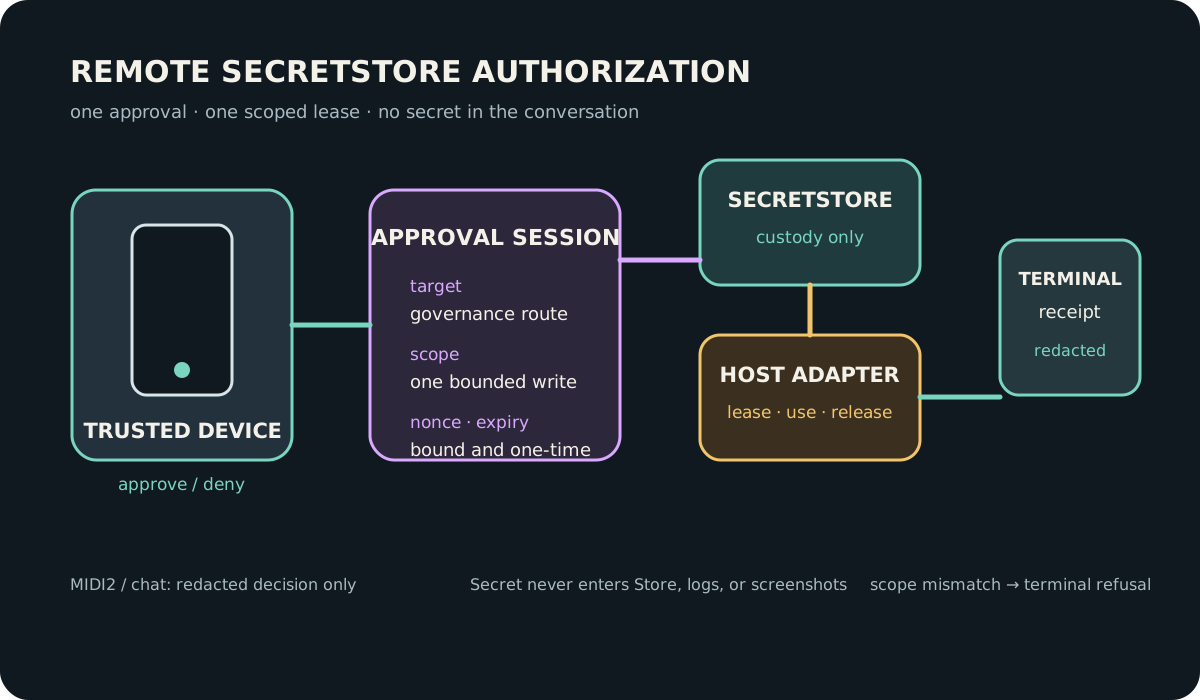
Principal illustration — a deterministic architecture projection. It is not a credential, approval receipt, Keychain prompt, provider response, or live acceptance evidence.
The decision
Secret custody and user approval are separate authorities. SecretStore owns the credential. The approval session owns the person's decision about one operation, target, scope, and time window. A native host adapter joins the two for one bounded request and returns a redacted terminal result.
operation request → approval session → trusted-device decision
                         ↓
             native adapter → short-lived lease → typed receipt
This is one reusable MaintenanceKit boundary. Git, estate publication, DNS, remote installation, recovery, and provider operations consume the same session contract; none invents a credential prompt or a second secret path.
Custody, approval, and transport
The request carries an opaque SecretStoreReference, never a token or password. It names the exact target and scope, a one-time nonce or idempotency key, an expiry, and the correlation identity. Reframe may expose those redacted facts through its MIDI2 and AX surfaces so a person can understand what is being authorized.
The trusted device approves or refuses the request. A phone or tablet is an approval surface, not a remote Keychain reader and not a place to paste a production secret into chat. The approval response is bound to the nonce, target, scope, and expiry. A stale, replayed, broadened, or mismatched decision is refused before transport admission.
The host-side SecretStore provider resolves the reference in the custody domain appropriate to the target. That may be the local macOS Keychain, a Linux Secret Service implementation, or an authenticated remote SecretStore/host agent. The provider releases the credential only inside the admitted native adapter closure and only for the lease lifetime.
Local and remote policy
Remote work must prefer a remote SecretStore or host-agent custody path when one is available. A local Keychain prompt is not a valid substitute for an unavailable remote approval path: it may be used only when the local host and its approval mechanism are explicitly part of the selected session. If no eligible provider is available, the operation ends immediately with a typed authorization-required, credential-unavailable, or approval-expired result. It does not hang while waiting for a person to reach another computer.
The same contract works on macOS and Linux. Platform providers implement custody and user-presence details; MaintenanceKit owns the session state machine, redaction, anti-replay checks, lease lifetime, and evidence shape.
Lifecycle and evidence
requested → awaiting-approval → approved → credential-leased → executing → succeeded
                         └→ denied / expired / unavailable / replayed / canceled / failed
The terminal receipt records the operation, target, scope, reference identity, nonce/correlation, provider class, approval state, lease outcome, and terminal result. It may include a non-reversible credential fingerprint for correlation, but never the credential, Keychain account value, or SecretStore payload. MIDI2 lifecycle events and FountainStore evidence carry the same redacted identity.
Authorization is not completion. A successful authorization proves only that a bounded adapter may attempt its operation. The operation's own Store receipt, remote read-back, AX evidence, or deployment proof remains necessary for its separate DoD.
Required failure behavior
- a missing or malformed reference;
- a target or scope that differs from the approved request;
- a reused nonce or idempotency key;
- an expired request, approval, or lease;
- an unavailable provider or missing credential;
- an approval from an untrusted or unbound device; and
- a request that attempts to place secret material into chat, MIDI2, Store, logs, or evidence.
Each refusal is terminal, typed, redacted, and correlated. No provider-specific fallback may silently widen scope or switch to a local prompt.
Integration rule
Existing host adapters such as Git and estate synchronization must depend on the shared authorization-session protocol, not instantiate Keychain storage directly. The adapter receives a scoped lease through MaintenanceKit, performs its operation, and releases the lease. The user-facing command remains semantic and scenario-bound; the approval instrument does not become a second command grammar.
Acceptance boundary
This chapter governs the reusable authorization boundary. It does not claim that a phone approval client, remote SecretStore broker, passkey flow, or provider operation is implemented or live-accepted. Implementation requires platform-provider fixtures, replay/expiry/target-mismatch negatives, redaction checks, MIDI2 and Store terminal receipts, macOS and Linux provider tests, and one end-to-end remote approval witness. A local Keychain prompt alone is not evidence of remote approval support.
Interlinks
Chapter 20 governs credential custody and explicit spending decisions. Chapter 62 defines authenticated maintenance operations and receipts. Chapter 63 defines the reusable Swift kit boundary. Chapter 94 defines provider-neutral authorization and SecretStore references.
Governing sentence
Approve the exact operation on the device at hand; let the native host adapter obtain a short-lived SecretStore lease; and leave the secret outside every conversation, MIDI2 message, Store receipt, log, and screenshot.