
Current Storify reading boundary · The maintained source-admission, named-range, reasoning, MIDI2, and terminal-evidence contract for Storify Source Auto.
85 — Storify Source Auto Reads a Defined Whole
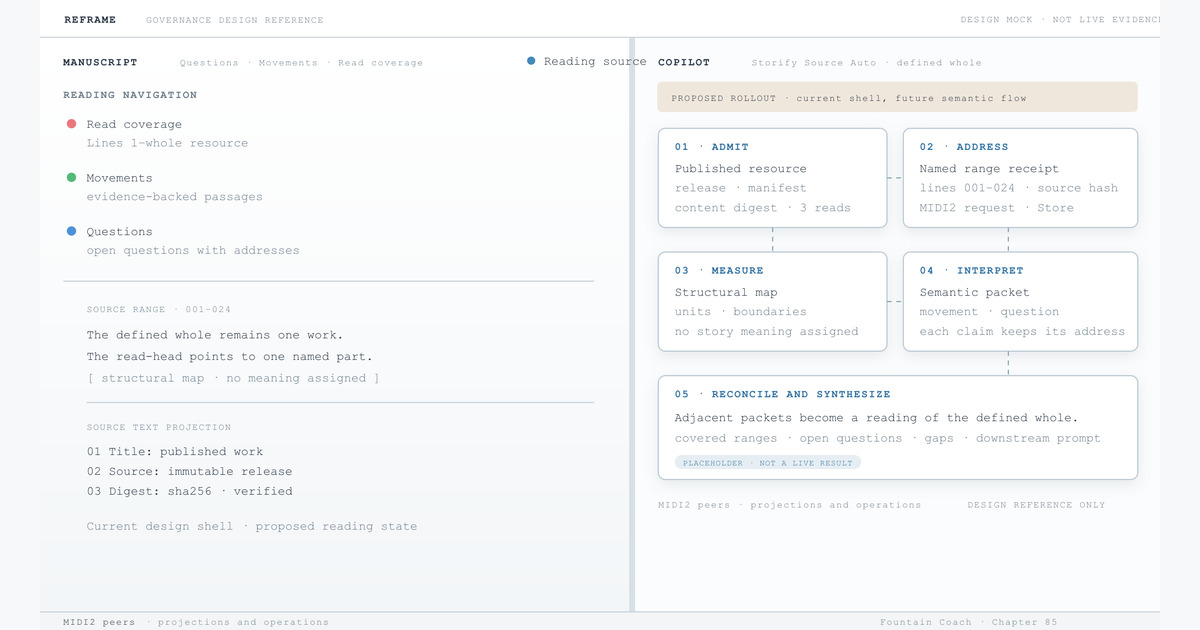
Storify Source Auto is not a text dump, a web scraper, or a model prompt with a progress bar. It is Reframe's governed reading pipeline: a named, immutable text resource is admitted, addressed by ranges, measured for structure, interpreted in bounded semantic passages, and reconciled into a reading of the defined whole.
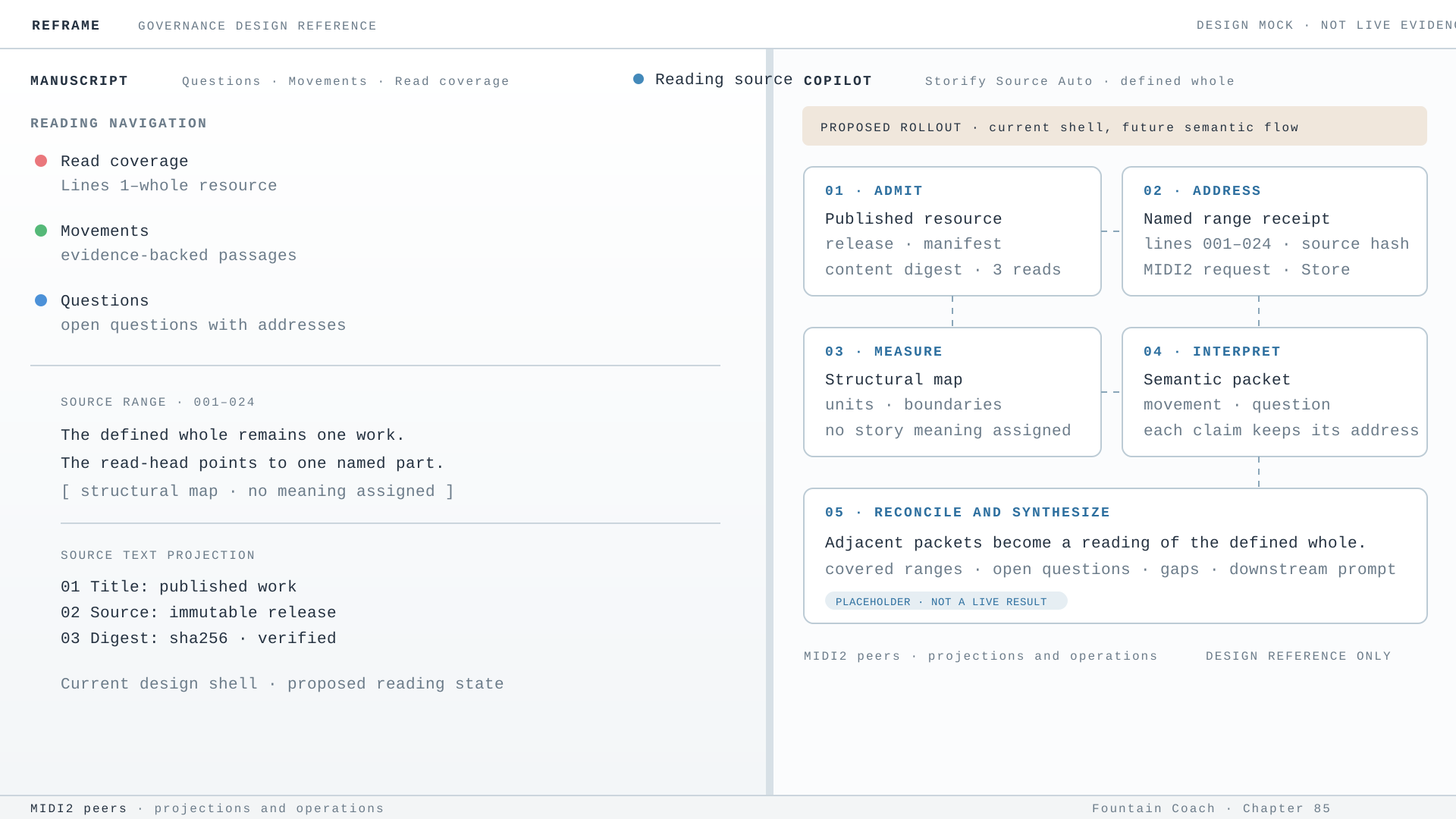
Design reference only. This mock uses the measured Chapter 84 Reframe shell and proposes the Chapter 85 reading flow; it is not an AX observation, FountainStore receipt, MIDI2 lifecycle trace, semantic result, or live acceptance.
Mock provenance: declarative SVG renderer v1; input identity chapter-84-shell + chapter-85-defined-whole-flow; asset SHA-256 f73de08e7d7bdc04312170d8c1a4e9c367ca76dc06cd7765076ad5273921b6ff.
This chapter joins the source-provider boundary of Chapter 56, the addressable text contract of Chapter 50, the measurement/interpretation separation of Chapter 29, the lane decision of Chapter 51, and the MIDI2 command boundary of Chapter 81. It defines their joint behavior for Storify Source Auto. It does not override the MIDI2 IDL, live FountainStore state, or a named build's actual acceptance status.
The decision
The defined whole is established once by an immutable source identity. Its parts are then read by named ranges. A deterministic structural map describes where those ranges are; it does not describe what they mean. Storify interprets one semantically relevant range at a time, records the evidence coordinates, and only then allows a later synthesis to reason across the packets that cover the whole.
The source is not fetched repeatedly from a floating cloud representation. The provider release, manifest digest, content digest, and exact bytes are admitted through the native Store boundary. That custody is authoritative source state, not a content cache. A rebuildable index may be reused when its source digest and parser revision match; it holds coordinates and structure, never a second copy of the source text.
What Source Auto does
One Source Auto run has these governed stages:
- Resource admission — resolve a published resource by name, pin its provider release, verify its manifest and content digests, and require three consecutive identical reads before the source becomes readable.
- Structural measurement — derive ordered units, chapters, paragraphs, speeches, stage directions, sentences, names, and other observable boundaries. Measurement may report ambiguity or missing boundaries; it may not assign story meaning.
- Range planning — choose the next named source range from the measured structure and the current semantic question. The planner preserves causal order and continuity. It does not shrink, truncate, or discard meaningful source material because a numeric token or character estimate is convenient.
- Local interpretation — give the selected passage, its coordinates, the relevant carried question, and only reasoned adjacent context to the semantic model. The response is typed and must cite the source range it interpreted.
- Boundary reconciliation — compare adjacent interpretation packets when a movement or question crosses a range boundary. A merge or split requires evidence from the packets and remains distinct from the structural map.
- Whole-work synthesis — derive the reading, question ledger, movements, uncertainties, and downstream prompt material from the persisted interpretation packets. The synthesis does not reopen the cloud source or require the whole manuscript to be placed in one prompt.
- Terminal projection — persist the run, range packets, coverage, job lifecycle, and capability receipt as one reconciled Store result. A model response, UI progress line, or log is not terminal proof.
Apple-native local reasoning, paid extension
The pipeline is deliberately composed rather than split into an exclusive local lane and paid lane. Apple-native Natural Language instruments provide the deterministic local foundation: language recognition, token and sentence boundaries, lexical and name observations, and embedding continuity where the selected framework supports it. A paid model may then enrich or synthesize those grounded packets when the Chapter 51 decision selects the paid writer-facing lane. The paid stage receives the local receipts; it does not replace source admission or invent a new source copy.
The seven stage boundaries are typed MIDI2 operations:
| Stage | Operation | Contractual result |
|---|---|---|
| measure | reframe/semantic.measure |
source-addressed structural and linguistic evidence |
| embed | reframe/semantic.embed |
source-addressed embedding continuity receipt |
| interpret | reframe/semantic.interpret |
bounded semantic packet with cited range |
| enrich | reframe/semantic.enrich |
paid-lane enrichment linked to interpretation receipts |
| reconcile | reframe/semantic.reconcile |
boundary comparison and explicit unresolved gaps |
| synthesize | reframe/semantic.synthesize |
whole-work reading from reconciled packets |
| prompt | reframe/illustration.prompt |
grounded movement/question prompt with placement relation |
The operation handoff carries the immutable source reference, prior receipt identities, lane decision where required, framework/model revision, and idempotency key. Payload custody remains in FountainStore. The portable operation contract is being extracted into FountainSemanticPipelineKit; until that boundary is released upstream and wired to Reframe executors, this chapter governs the target architecture rather than claiming that the complete chain is live.
Fast reading without a content cache
The fastest correct path is:
published resource
  → three-read immutable admission
  → native FountainStore source custody
  → digest-keyed structural map
  → named range receipt
  → semantic packet
  → reconciled reading
Metadata, release manifests, and independent future ranges may be requested concurrently. Causal reading may not be parallelized merely to reduce wall-clock time. The next range may be prefetched after the current range has been admitted, but it cannot be interpreted or counted as covered before its own receipt exists.
An HTTP conditional request, provider-side immutable release, or transport read-ahead may optimize delivery, but none of them becomes semantic authority. The source digest and Store receipt remain the identity that downstream stages consume.
Reasoning over parts of a defined whole
The model receives the smallest semantically sufficient context for the current phase, selected by meaning and continuity rather than by numeric fit. The pipeline keeps four different objects separate:
| Object | Authority | Contains | Does not contain |
|---|---|---|---|
| Source resource | provider release and Store | immutable text and digest | interpretation |
| Structural map | deterministic measurement | ordered ranges and observable boundaries | story conclusions |
| Interpretation packet | Storify/model response | movement, question, uncertainty, and cited evidence | uncited whole-work claims |
| Whole-work synthesis | reconciled packets | relations across covered ranges and coverage gaps | invented source material |
Adjacent packets may carry forward an open question or unresolved continuity. A carried question is context, not proof. The packet must still cite the range that supports each new claim. A gap remains a gap; synthesis may not silently fill it from memory, a prior model response, or a nearby range.
This makes local reasoning composable: a chapter, scene, or bounded myth can be read independently while retaining an address into the same defined whole. It also makes reruns explainable: a changed source digest invalidates its derived map and interpretation packets; a changed operation revision invalidates only the affected derived stage.
MIDI2-native exchange
MIDI2 is the operation and lifecycle boundary, not a second text store. The resource read operation names:
- the resource and source document identity;
- provider release, manifest digest, and expected content digest;
- the requested line or unit range;
- the required consecutive-read count;
- an idempotency key and execution identity.
The verified data receipt returns the same identity, the exact range, content digest, and read count together with the range text or a native Store reference appropriate to the payload contract. Large source custody remains in native FountainStore; MIDI2 carries the typed request, admission, range receipt, lifecycle, error, and terminal references.
The adapter mirrors the declared IDL topics without changing their meaning. It must not fetch a different resource, silently widen a range, allocate a second execution identity, or turn a timeout into completion. Replayed requests with the same idempotency key return the same admitted result or the same typed failure.
Rules
- Source Auto MUST name the immutable resource, provider release, manifest digest, content digest, and source revision before interpretation begins.
- Three consecutive exact reads MUST agree before a resource is admitted as stable. A mismatch MUST fail closed.
- Storify MUST consume the admitted Store resource or a verified named-range receipt; it MUST NOT independently re-fetch a floating cloud source.
- A range request MUST return only the named range, within the declared payload contract. Whole-work fetch followed by client-side slicing is not an implementation of named-range reading.
- Structural measurement MUST remain factual. It may locate boundaries and observations but MUST NOT assign a beat, movement, question, uncertainty, or causal meaning.
- Numeric token, byte, character, or atom limits MAY be transport telemetry and provider constraints, but MUST NOT decide which semantically relevant source material is included, truncated, compacted, or discarded.
- Every interpretation packet MUST carry source coordinates, source digest, operation revision, and typed evidence for its claims. A summary without an address is not a grounded result.
- A synthesis MUST distinguish covered ranges, unresolved gaps, carried questions, and reconciled movements. It MUST not present a partial read as a complete reading.
- MIDI2 lifecycle, native Store receipts, AX state, window-ID capture, and logs are separate evidence authorities. No one of them may stand in for the others.
- A run is accepted only when its declared terminal predicate is satisfied and the same result is reproduced across three independent repetitions. Intermediate progress is not acceptance.
- Downstream image or illustration generation MUST consume only grounded movement/question packets with source addresses. It MUST NOT use raw cloud text or an unverified model synopsis as its prompt authority.
- A public governance projection MAY describe this contract and its evidence boundary, but MUST NOT publish private Store data, prompts, manuscript material, credentials, or unestablished runtime claims.
Current implementation boundary
The deterministic Book Library reader and the resource-read topics establish part of this contract: provider and content digests are checked across three reads, and the IDL names the resource request and data receipt. The seven semantic operation identities and generated facts are now declared, and the portable handoff contract has a tested pre-release package boundary. The current Swift adapter does not yet execute the complete chain through external MIDI2 and matching Store receipts. The existing Source Auto path still contains whole-source acquisition and fit-driven window mutation. Semantic quality gates that reject dump-like interpretations before illustration generation are not yet live-accepted.
Those are implementation slices governed by this chapter, not claims established by publishing it.
Governing sentence
Storify Source Auto reads a named, immutable whole through verified ranges, reasons over each part with its address, and may speak across the whole only from persisted, reconciled evidence; MIDI2 coordinates the operation, FountainStore holds the authority, and no progress signal becomes truth until the declared terminal evidence agrees.