
Current scenographic-policy boundary · The maintained conversion of Semantic Scenographer governance into a versioned typed Kit policy enforced by ReframeCore and realized by TeatroStageEngine without a second source or uncertainty authority.
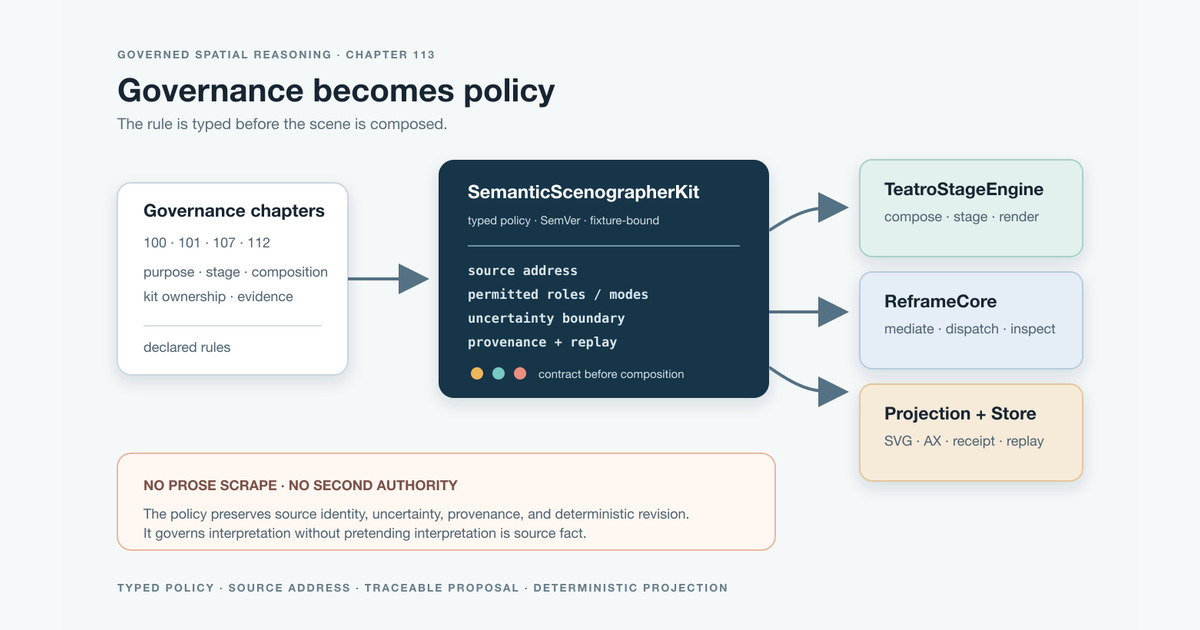
Governance Becomes an Executable Scenographic Policy
Chapter summary: The Semantic Scenographer becomes more capable when its governing rules are converted into a typed, versioned policy owned by
SemanticScenographerKit. Reframe enforces the policy, TeatroStageEngine realizes the composition, and neither becomes a second source or uncertainty authority.
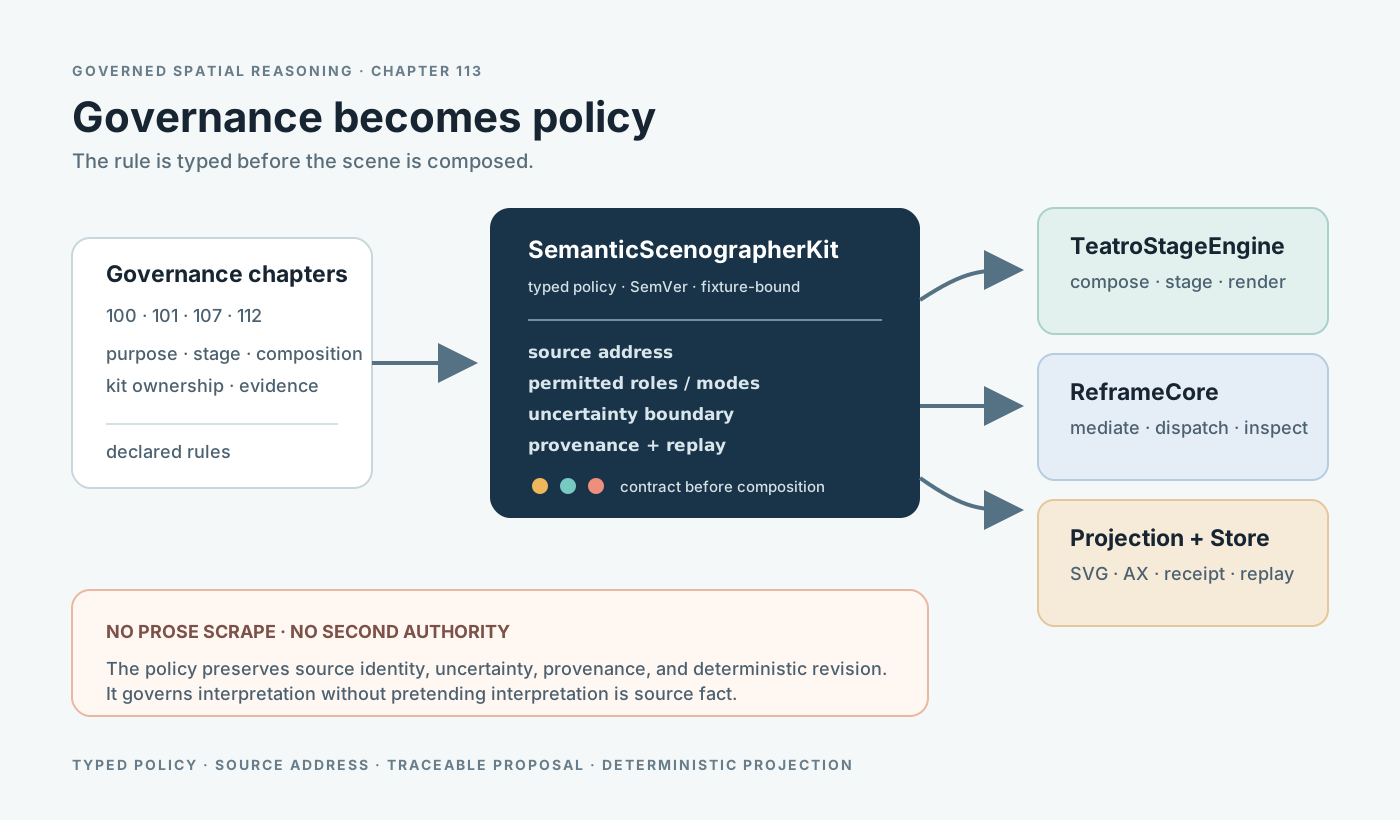
Principal illustration — a deterministic Teatro-style vector projection of the policy boundary. It is an architectural explanation, not a runtime screenshot, live acceptance result, or claim that the full engine integration is released.
The decision
Chapter 100 defines what the Semantic Scenographer is. Chapter 101 defines TeatroStageEngine as the stage boundary. Chapter 107 governs creation of the canonical composition layer. Chapter 112 establishes that the capability contract must live in a Swift kit.
This chapter governs the conversion between those decisions and an executable capability:
governance chapters
        ↓
typed SemanticScenographerPolicy
        ↓
SemanticScenographerKit request/result
        ↓
TeatroStageEngine composition
        ↓
deterministic SVG, stage, animation, or inspection projection
Governance is therefore not scraped from prose at runtime, and it is not left as advice to a model. The policy is a versioned, testable Kit object. A policy change is a contract change with explicit review, fixtures, and provenance.
Why this raises quality
An unconstrained scenographic prompt can produce an attractive but weak answer: an object may have no source address, a visual relation may be mistaken for a fact, uncertainty may disappear, and a flattened image may be impossible to revise or inspect.
An executable policy makes quality conditions structural. Before composition, the Kit can require:
- an exact source document and range;
- the admitted beat, movement, lane, note, or composite address;
- declared scenographic roles and relations;
- an explicit interpretation boundary;
- a permitted Teatro mode and projection contract;
- provenance, instrument, policy, engine, and renderer versions;
- deterministic replay inputs and a typed terminal result.
The policy does not tell the AI what a passage means. It makes the conditions for a responsible spatial proposal unavoidable and inspectable.
The policy contract
SemanticScenographerKit owns one stable policy identity and its SemVer evolution. The first contract should express the smallest useful set of constraints:
SemanticScenographerPolicy {
    identity
    version
    permittedModes
    permittedRoles
    addressRequirement
    uncertaintyBoundary
    provenanceRequirement
    determinismRequirement
    revisionAndVariantRules
}
The policy may admit modes such as stage-plan, relational-diagram, storyboard, temporal-score, or memory-vector. It may admit roles such as figure, field, threshold, trajectory, void, and witness. These are declared compositional vocabulary, not hidden semantic findings.
The policy must reject or visibly mark a request when the source address is missing, when the requested role is not admitted, when uncertainty would be silently converted into certainty, or when a renderer cannot preserve the required identity and provenance.
One authority chain
The conversion must preserve the architecture already established by Chapters 99–107:
| Boundary | Owns | Must not become |
|---|---|---|
| Reading Navigation | the writer's semantic starting address | a spatial interpretation |
| Source View | exact Markdown and supported .fountain source |
a generated scene |
UncertaintyScoreKit |
internal uncertainty state and addresses | a second writer-facing navigation system |
SemanticScenographerKit |
typed policy, request, proposal, and result | source or uncertainty authority |
| TeatroStageEngine | stage composition, geometry, state, and rendering mechanics | semantic interpretation |
| ReframeCore | mediation, dispatch, identity, and capability routing | an untyped prompt router |
| FountainStore | durable evidence, receipts, and replay inputs | a renderer |
The important new edge is between governance and the Kit: governance declares the rule; the Kit carries its executable form. No downstream component may invent a competing version.
The request and result
The writer remains in Copilot, but the writer-facing request is resolved into a typed instrument request rather than a private prompt convention:
SemanticScenographerRequest {
    sourceAddress
    admittedContext
    policyIdentity
    mode
    requestedRelations
    variantIdentity
}
The result must distinguish interpretation from realization:
SemanticScenographerResult {
    proposalIdentity
    sourceAddress
    teatroComposition
    policyVersion
    engineVersion
    rendererVersion
    provenance
    terminalState
}
The AI proposes relations. The Teatro composition records those relations. TeatroStageEngine realizes stage state. Rendering is deterministic from the stored composition and render parameters. A beautiful image without these joins is an illustration, not an accepted scenographic result.
Rendering quality is part of the contract
The policy governs not only what may be represented, but whether the representation can be read. For a canonical Teatro-style diagram or chapter illustration:
- geometry and typography are authored in a scalable vector asset whenever the medium permits;
- text is sized for the actual responsive chapter canvas, with internal padding and explicit wrapping;
- outlined glyph paths are acceptable only when they remain legible at intrinsic and responsive display sizes;
- small labels are not used to carry essential meaning that the composition cannot support at readable scale;
- the social JPEG is derived from the canonical asset and may not become an independently composed fallback;
- canonical and social outputs are checked separately, because vector sharpness does not survive every raster delivery.
This is a quality invariant, not a cosmetic preference. If a reader cannot distinguish the labels, the semantic relations have not been projected successfully.
Variants and revision
Spatial reasoning has no requirement to produce one canonical visual answer. The Kit must support distinct variants anchored to the same source address:
same source address
    ├── variant A · compression
    ├── variant B · distance
    └── variant C · shared field
Each variant remains a proposal. Revising a threshold, trajectory, or field creates a new proposal identity and keeps the prior score inspectable. It does not rewrite the source, close an unresolved question, or promote an interpretation into evidence merely because it was rendered.
Implementation status and boundary
The repository already contains a FountainCoachSemanticScenographerKit with source addresses, scenographic roles, structured Teatro objects, and a deterministic SVG renderer seam. The current boundary is therefore concrete enough to govern, but this chapter does not claim that every policy field, the full TeatroStageEngine package dependency, all host adapters, or live acceptance are complete.
The next implementation must extend the existing Kit and Teatro contracts at their owned boundaries. It must not add policy parsing to a UI, scrape governance pages during execution, introduce a second scene engine, or use Python as a runtime fallback for a Kit-owned capability.
Acceptance
The conversion is accepted only when a focused fixture proves that:
- the same source address produces a typed policy-bound request;
- missing or ambiguous addresses fail visibly;
- the policy forbids unadmitted roles and silent uncertainty closure;
- the proposal preserves source and uncertainty references on its objects;
- the Teatro composition can be rendered by more than one admitted projection;
- rerendering a stored composition is deterministic;
- variants remain separate and revisable;
- ReframeCore dispatches the Kit contract through its governed MIDI2 or host-adapter route;
- FountainStore records the terminal result and provenance;
- AX and the MIDI2 monitor expose the same stable identities used by the Kit;
- the canonical vector projection and its social derivative pass responsive legibility, padding, wrapping, and clipping review independently.
Until these predicates have matching implementation and evidence, the policy remains a governed target rather than a released capability.
Relationship to existing governance
- Semantic Scenographer defines the instrument's purpose and interpretive boundary.
- TeatroStageEngine Is the Stage defines the stage authority.
- Semantic Inference Execution defines the isolated execution session and terminal evidence.
- FCIS-KIT Semantic Factory defines the composed instrument lifecycle and correlated MIDI2 stream.
- Teatro MIDI2 Monitor defines the runtime projection and replay boundary.
- Canonical Teatro Stage Composition Layer defines the composition-layer creation boundary.
- Skill and Maintenance Capabilities Are Kit-Owned requires this policy's executable home to be the appropriate Swift Kit.
Governing sentence
Governance for the Semantic Scenographer becomes operational only when its rules are represented by a versioned typed policy in SemanticScenographerKit, enforced by ReframeCore, and realized by TeatroStageEngine without becoming a second source or uncertainty authority.