
148 — Production Runtime Nodes Are Artifact-Only
Governance chapter: 148. Production machines execute admitted releases; they do not construct them. Build-on-production is forbidden.
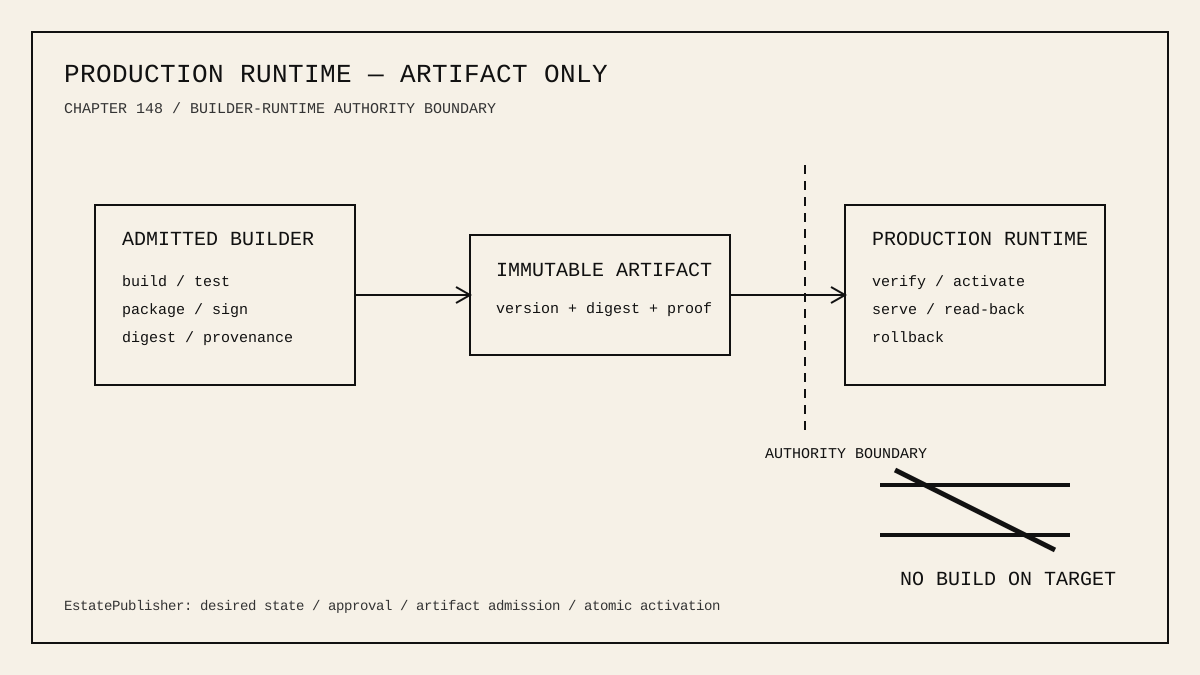
Principal illustration — the builder/runtime separation. It is an architectural rule, not a live deployment receipt.
The decision
A production runtime node MUST NOT run source compilation, package resolution, dependency checkout, linking, or release assembly as part of deployment. EstatePublisher admits only a prebuilt, tested, immutable, digest-bound artifact across the production boundary.
source + exact dependencies
          │
          ▼
admitted builder / staging instrument
 build · test · package · sign · digest
          │
          ▼
EstatePublisher approved desired state
          │ immutable artifact
          ▼
production joining machine
 verify · activate atomically · read back
          │ failure
          └────────────► previous release remains active
Why this is a system boundary
The production Hetzner node demonstrated the difference directly. With only its runtime workload it serves the estate quickly. During remote Swift compilation the same one-vCPU, approximately 2 GiB node experienced CPU contention, cache eviction, I/O pressure, repeated system memory-pressure events, and an OOM kill of swift-frontend. The resulting latency variance and outage risk were created by mixing builder and runtime roles.
The conclusion is architectural rather than incidental: production serving capacity must never be consumed to construct the candidate that may replace the serving process.
Normative invariants
- Production release promotion MUST NOT invoke
swift build,swift package, compiler, linker, package resolution, or dependency checkout. - The builder is a separately admitted machine or instrument: developer Mac, Ubuntu staging/builder, or another explicitly governed builder.
- The promoted unit is an immutable artifact identified by artifact version, source revision, digest, and provenance.
- The production joining machine verifies the artifact before activation and does not infer trust from transfer success.
- Activation is atomic. The previous accepted release remains available until health and public read-back succeed.
- Build caches and source worktrees are not production prerequisites.
- Adding production CPU or memory does not legalize remote builds. Scaling runtime capacity and building releases remain separate responsibilities.
Authority map
| Concern | Authority | Production role |
|---|---|---|
| source and dependency graph | Git + exact resolved dependency state | none |
| build/test/package | admitted builder or staging instrument | none |
| release authorization | EstatePublisher + owner/trusted-device approval | verify authorization |
| artifact admission | digest/signature/provenance contract | verify received bytes |
| activation | production joining-machine capability | atomic switch |
| acceptance | typed health + public read-back receipt | serve and witness |
Relationship to EstatePublisher
EstatePublisher remains the publication authority. Its production release executor must fail closed if only a source-build-on-target path is available. Legacy source-build adapter code may remain temporarily for migration or history, but it is not an admissible production path. The executable production path transfers a prebuilt artifact to the joined production machine and requests verification and activation.
Relationship to joining machines
Chapter 141 remains controlling: every joining machine is a governed MIDI2 instrument. This chapter narrows the production instrument's capability set. A production instrument may admit, verify, activate, inspect, roll back, and report a release. It must not silently acquire the role of compiler or CI worker.
Capacity rule
Sizing a production runtime is based on serving, persistence, media, and bounded maintenance workload. Build capacity is sized separately on the builder/staging plane. Scaling production does not legalize build-on-production; it only adds runtime capacity.
Acceptance
The decision is pinned at four layers: governance, EstatePublisher runtime policy, CLI/documentation, and tests. A future regression that attempts build-on-production must be rejected before a remote compiler can start.
Governing sentence
Builders construct and prove immutable artifacts; production runtime nodes verify, activate, serve, and roll back them — they never compile the release they are meant to serve.