
157 — The Writer Owns the Public Domain
Governance chapter: 157. Reframe lets a writer make an owned public domain part of the writing itself: a durable place for authored meaning, publication, identity, and continuity. Fountain Coach provides capability without becoming the writer's namespace.
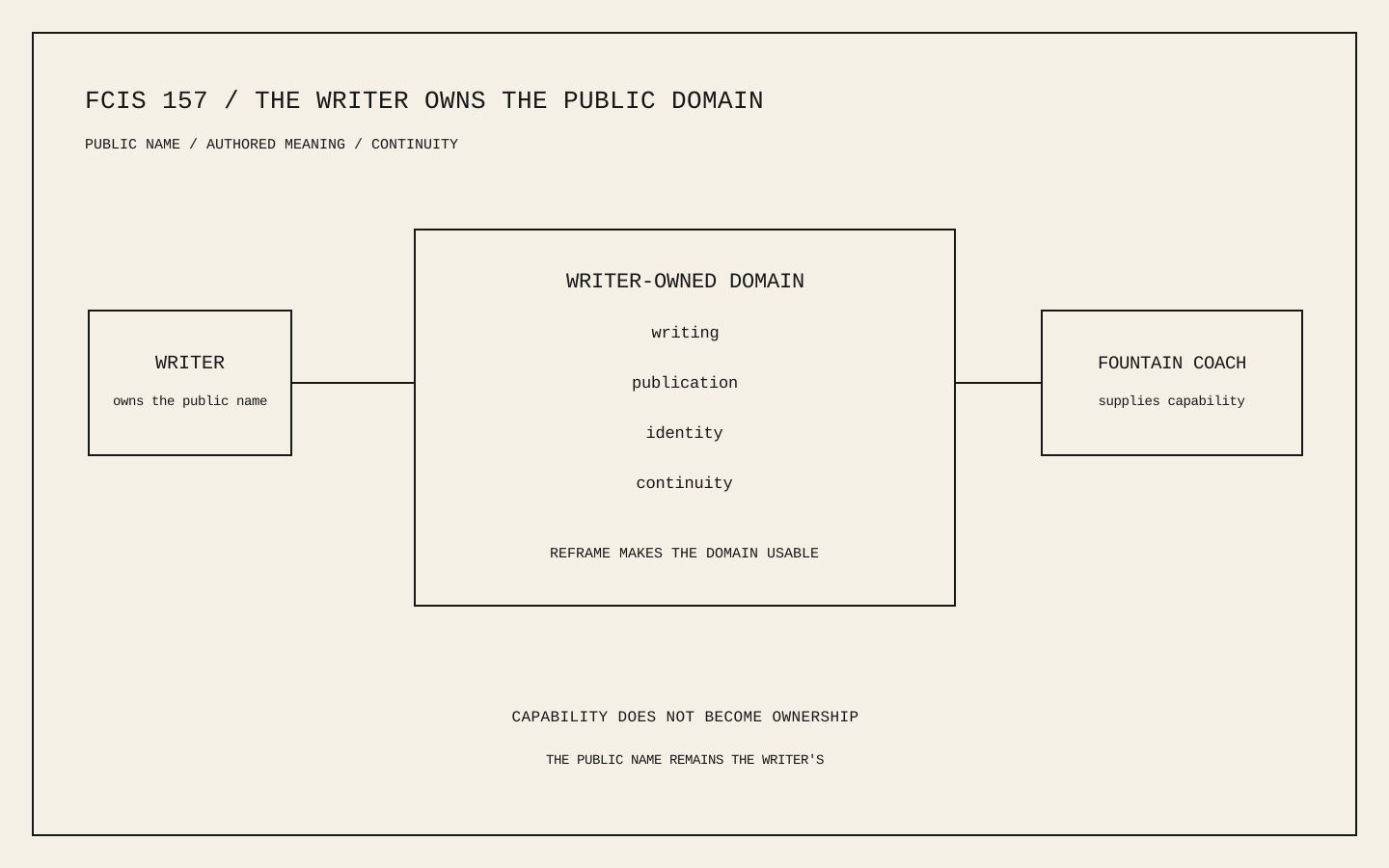
The decision
A Reframe writer may establish a public writing domain under a registered internet domain controlled by that writer.
The domain is not an account name translated into a URL and not a tenancy borrowed from Fountain Coach. It is the writer's public name and may remain so independently of Reframe or Fountain Coach.
Reframe makes that name useful as a domain of writing.
writer
  owns the public name
    ↓
writer-owned domain
  contains and identifies
    ↓
writing · publication · identity · continuity

Reframe
  makes this relationship usable
A domain is more than an address
For Reframe, a public domain is not merely the location at which files happen to be served. It is a durable context in which authored meaning can accumulate.
Within it, a writer may bring together works, editions, references, media, public and protected surfaces, identity, and future forms of authored interaction. The domain gives these things a stable public relation to one another.
The writer should experience this as one coherent domain of work, not as a collection of infrastructure products.
Semantic domain and public name
A semantic domain is a coherent field of authored meaning: a work, corpus, research field, dramatic world, publication, or another bounded context.
A registered internet domain is a globally delegated public name.
Reframe may contain many semantic domains without making them public. When a writer chooses to give authored meaning a durable public home, Reframe can join semantic domain and public name without confusing them.
semantic coherence ≠ ownership of an internet name
ownership of an internet name ≠ authorship

Reframe relates them without collapsing them.
Identity follows the writer-owned domain
A writer-owned domain may also carry the writer's public identity and the authority relationships needed by Reframe capabilities.
Chapter 142 governs the reusable authorization capability. Reusing that capability does not turn every Reframe writer into a tenant of one Fountain Coach identity system.
The governing relation is simpler:
writer-owned domain
  → writer-domain identity
  → admitted Reframe capabilities
Fountain Coach may supply software or services that make this possible. The writer's public identity remains attributable to the writer's domain.
No tenancy substitution
Reframe MUST NOT silently substitute a Fountain Coach namespace for a writer-owned public domain and present the two as equivalent.
A writer may work locally, privately, provisionally, or without any public domain at all. Those are legitimate states. The absence of a public domain does not require Reframe to manufacture a substitute public identity.
When a writer does establish a public domain, that domain—not a Fountain Coach account address—is the canonical public name.
Ownership means continuity
The public name should remain the writer's even when the surrounding means of operating it change.
This is the product meaning of portability. Reframe should help the writer preserve continuity of public identity and authored meaning rather than bind either one to a particular implementation, provider, installation, or commercial relationship.
The governing distinction is:
capability relationship
  ≠
identity ownership
Fountain Coach provides capability, not tenancy
Fountain Coach may provide Reframe, authorization capability, publication capability, storage, synchronization, automation, and other services used by a writer's domain.
Those services can be deeply integrated without becoming ownership of the writer's namespace.
Reframe should become more useful as the writer's domain grows richer. It should not make the writer's public name less their own.
Intended writer experience
From the writer's perspective, the relationship is:
I have a domain
  → Reframe recognizes it as mine
  → I shape what it means
  → I decide what becomes public
  → my public name remains mine
The mechanisms beneath that experience are governed by their respective capabilities. This chapter does not prescribe a publisher, deployment topology, credential store, staging environment, certificate mechanism, or development workflow.
Conformance
A Reframe implementation conforms to this chapter when:
- a writer-controlled registered domain can be the canonical public identity of the writer's Reframe domain;
- no Fountain Coach subdomain or account namespace is required as that canonical identity;
- writer-domain identity remains distinct from Fountain Coach organizational identity;
- Reframe can represent private, local, provisional, and public states without inventing a substitute tenancy;
- the public name can remain stable while replaceable implementation details change; and
- the writer can understand the relationship as ownership of a public domain rather than rental of a software-vendor namespace.
Governing sentence
The writer owns the public name. Reframe makes that domain meaningful and usable for writing. Fountain Coach supplies capability without becoming the writer's landlord.