
161 — Host Enrollment, Client Consent, and Access Management
The owner admits the relationship. A client may receive a bounded grant to use an instrument, but neither a login nor a connecting protocol acquires ownership of it.
Decision: Fountain Host access SHALL be administered as explicit, revocable relationships among a human principal, an admitted Host, an identified client, and finite instrument capabilities. The management interface SHALL display and mediate those relationships; it SHALL NOT constitute an independent authorization database or execution authority.
Purpose and boundary
Fountain Coach already separates identity and authorization (Chapter 142), Host capability execution (Chapter 152), and the writer's domain sovereignty (Chapter 157). This chapter governs the owner-facing administration that joins those authorities without replacing any of them. It applies whether the Host runs on Hetzner, an admitted local machine, or another owner-controlled environment.
A single-owner service MAY be administered without a separate public management website. Once access is delegated to other people or independent clients, owners SHALL have an accessible way to review their relationships, grant or refuse requested capabilities, and revoke them. A browser projection is the recommended cross-platform experience; a native client or owner-controlled CLI may offer the same governed operations.
The relationship, illustrated
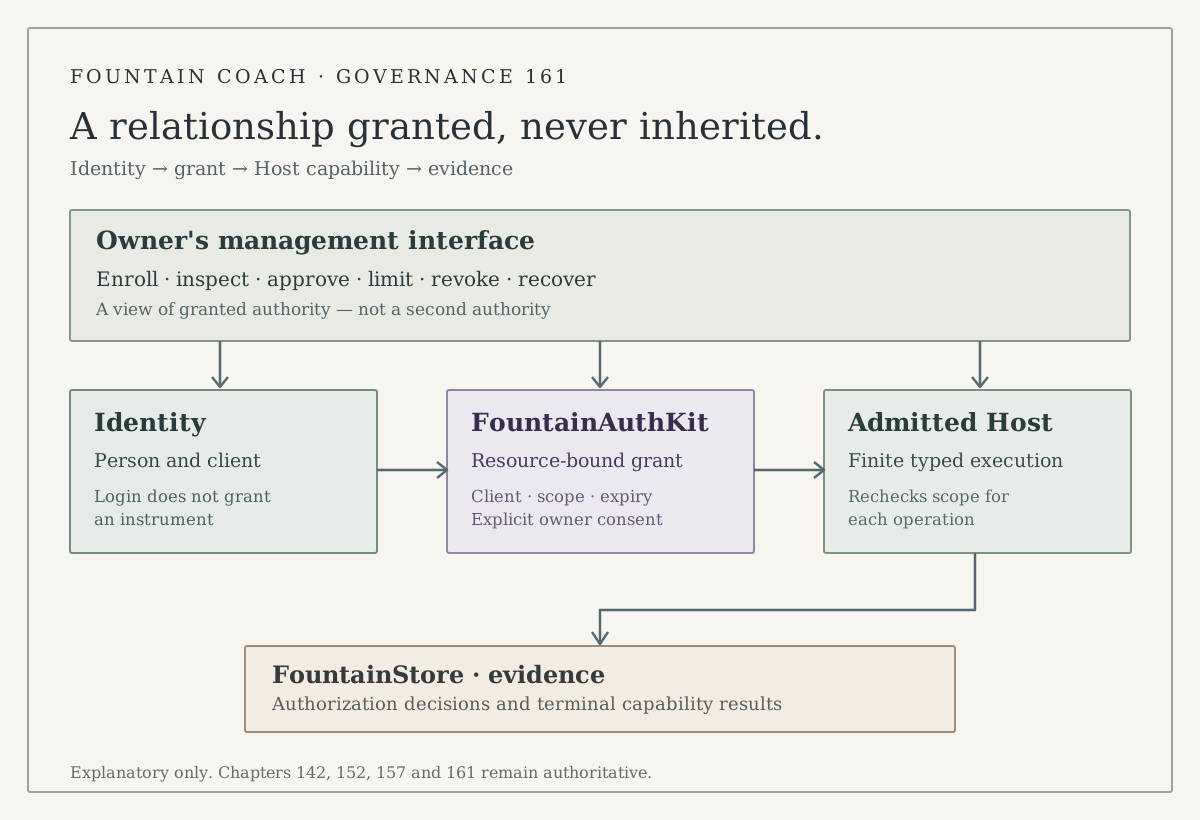
One decision, separate authorities
- Human identity. Authentication identifies a person by an admitted mechanism; a provider's identity claim is not a Host permission. Chapter 142 owns authentication and the OAuth/OIDC policy.
- Ownership and enrollment. The owning subject admits a specific machine as a Host and defines its accepted environment and finite capability vocabulary. Chapter 152 owns Host execution, not the web interface.
- Client grant. A recognized MCP, native or web client requests permission for a particular resource and bounded operations. A client registration, discovery response, token possession or successful connection is not consent.
- Execution and evidence. The Host verifies the grant against the current policy and target before each operation. FountainStore records safe authorization and terminal evidence; a chat transcript or UI badge is not proof of an effect.
Neither ChatGPT, Remote Desktop Commander, a cloud provider, a DNS name, nor an OAuth front-end may silently become the root of Host authority. A managed Host remains governed when its client or transport changes.
Host and user enrollment
The enrollment ceremony SHALL bind an authenticated owner to one declared Host identity, its endpoint or admitted transport, the machine's verified key or equivalent trust evidence, the owner's resource boundary, the environment (development, staging or production), and the manifest of discoverable capabilities. A change of machine identity, ownership or admitted execution scope requires re-admission, not an alias edit that preserves stale grants.
Additional people MAY be invited into explicit roles. Invitation, authentication, membership, Host ownership and capability delegation are different states. Pending invitations grant nothing. An organization administrator MAY administer membership only if that authority was separately admitted; it does not confer unrestricted access to every owned Host.
Client registration and consent
The management surface SHALL show the requesting client's identity, its class and verified redirect or origin, the exact Host/resource, requested capability names, human-readable meaning, read-versus-mutation effects, environment, duration, and current grant before offering a decision. New or elevated permissions require an explicit authorization act; silence, an open browser, a remembered login, or approval for one Host do not grant another. Decline SHALL remain a fully supported result.
For MCP clients the flow SHALL use the admitted OAuth/OIDC profile, exact redirect validation and PKCE where appropriate. A consent record binds subject, client, resource, scope, policy revision, authorization event and expiry. A grant cannot exceed the owner's capability boundary. Unknown operations and stale client registrations fail closed. Least authority is scoped to meaningful capabilities, not a prohibition on useful work.
One resource-bound token MAY authorize several admitted read operations when the consent clearly names them. Mutation, publication, provider spending, destructive operations, environment promotion and delegation MAY require separate grants or fresh human confirmation under their owning chapters. Consent permits evaluation of an operation; it never compels execution.
What the owner must be able to manage
The interface SHOULD offer a comprehensible inventory of admitted Hosts and their health, connected clients, invited people, active and expired grants, capability scopes, environments, last authorized use, pending requests and refusals. It SHALL distinguish a real live observation from cached authorization state and a proposal from a deployed feature. Host names and capability inventories should derive from verified machine contracts, not prose maintained by hand.
Administrative changes SHALL go through the same typed FountainAuthKit/Host operations available to other admitted clients. The interface MUST NOT maintain a second editable permissions table that can overrule the issuer, a Host, or FountainStore. Administrative actions require accessible status, cancellation/refusal, terminal receipt, and explicit errors without exposing tokens or credential material.
Revocation, expiry and recovery
The owner SHALL be able to revoke a client grant, remove a user, disconnect a Host and retire a compromised machine credential. Revocation SHALL invalidate relevant refresh authority and deny subsequent protected operations within a declared, bounded propagation period; active jobs follow their explicit cancellation and completion policy, and may not be silently treated as never having run. Denial, revoked, expired, suspended, disconnected and unreachable are distinct states.
Lost browser sessions, lost devices or lost client vendors SHALL NOT strand an owned Host. Recovery must distinguish restoration of service from restoration of trust: key rotation, re-enrollment, prior grants, old sessions and cached state each require explicit reconciliation. Export and migration SHALL preserve the writer's own identity and domain rather than silently converting them into Fountain Coach tenancy.
Privacy, accessibility and separation
Public metadata MAY describe protocol support, sanitized capability vocabulary and release identity. Private names, membership, request history, tokens, keys, raw credentials, machine-private addresses and bearer grants must not leak into public pages, logs, analytics or screenshots. Store evidence retains only necessary safe identifiers and redacted outcomes under a declared retention policy.
Enrollment, approval, decline, inspection and revocation SHALL be keyboard- and assistive-technology-accessible, with legible mobile browser behavior. A consent screen is not accepted because it looks plausible in a static mock: the actual client, resource and permission must match the server's recorded request and the final token's authority.
Scenario-first acceptance
A release SHALL prove the complete owner journey: admit Host A; enroll a second person without authority; register Client C; refuse a request; grant read-only access to Host A; confirm the same grant cannot access Host B or invoke a write operation; inspect safe evidence; revoke Client C; verify refresh and subsequent access are refused; recover after service restart; and establish owner access through an independent permitted lane. The test MUST also cover client substitution, session expiry, stale authorization UI, redirected consent, unauthorized elevation, and an unreachable Host.
Proof requires separate records from the authorization issuer, the Host's accepted or refused operation, FountainStore, and the browser/AX projection. Do not claim full public management acceptance from local OAuth fixtures, a screenshot, published metadata or one successful MCP handshake. Identity, permission, effect and release remain distinct witnesses.
Current implementation and nonclaims
At the time of this chapter's drafting (8 November 2026), the owner-controlled Fountain Host MCP/OAuth service has been exercised with bounded tools and resource-scoped permissions. This chapter does not claim that a multi-user directory, owner-managed Host registry, passkey-based admin account, public grant dashboard, automatic delegated invitations or revocation UI is live or independently security-reviewed. Existing operational OAuth and local consent experiments are not equivalent to the full owner-facing lifecycle specified here.
The deployment arrangement itself is independent of the authority model. Moving the Host from a local Ubuntu computer to Hetzner changes operational custody, storage, backups and connectivity; it neither grants access to new people nor eliminates the consent and revocation contract.
Governing sentence
An admitted Host belongs to its owner. People and clients act only through explicit, resource-bound, revocable authority; the management surface makes that authority legible and operable without becoming its source, while every executed capability remains independently checked and evidenced.
Related authority: 142 — FountainAuthKit · 152 — The Host Is the Instrument · 157 — The Writer Owns the Public Domain · 160 — Skill Sovereignty.